We had a surprisingly effective and enjoyable walk today (we being: Dana, Gavain, and Tillwyn), weaving our carts in and out of traffic around the town of Kirksville, MO. Kirksville is 25 miles from our house, and is the nearest city with a population greater than 10,000 people. We brought the cart and wagon in by truck today (I'll explain why in just a bit), and paced around the town square, and over to the local super-market, about 1.5 miles away.
We did a bit of shopping in the grocery store, and for the occasion, we strapped a dry-erase board to the front of our cart, which read: "Do you know that a climate catastrophe is underway? Talk to us!" Mostly, for our troubles, we received a bunch of frowns, and some dirty looks, but one kind man did stop us in the parking lot, ask us where we were planning to pace, and wondered if we had yet received any media attention.
Afterwards, we walked our wagon and cart back the 1.5 miles to the square, where we encountered the homecoming parade for the Kirksville school system, just as it was warming up. Two marching bands, majorettes, a fire truck, floats with football players and prehistoric reunions, not to mention cameos by the Adair County Republican and Democratic election committees. We found a suitable spot by the sidelines, where our carts nonetheless drew considerable attention, and we had several valuable conversations about the climate.
At the end, we requested help loading our wagon and cart into the truck from some high schoolers who are volunteering for the Democratic candidate for State Representative of District 3 in Missouri. Dana had a chance to talk just a bit with the candidate herself, Rebecca McClanahan, and share with her about Pacing the Planet, and our concern with global warming. Ms. McClanahan was appreciative and supportive of our project.
We have modified our strategy this fall, so that we will be bringing our carts to special locations in our (soon-to-be) vegetable oil powered pickup truck, and then pace locally at those spots. Part of the reason for the change is that Dana is experiencing some health challenges that have been sapping her energy recently, and we need to take care of her. We also are valuing the practice for a more extensive endeavor in the spring.
Thirdly, we are evaluating our progress working with Jemma and Sasha, the donkeys; we believe that, with some more time for training, we can feel more confident in our relationship with them, and we believe we can train them to walk faster with us. (It is also possible that we will decide that the donkeys require more care and logistical support than they are worth to the project for the help they provide, but we haven't reached that conclusion, yet).
Last, we have so far found that, particularly since we are traveling with children, we have needed the help of a vehicle to ferry us supplies at the end of the day. If this is to be an implicit part of Pacing the Planet, we want to do it responsibly, by using our truck that can run on vegetable oil we reclaim from our local restaurants, and we need a driver (or drivers) who would be committed to the project, as well.
On Wednesday, Dana and I presented at Truman State University, in Kirksville -- our first college campus talk, with many more to follow, hopefully. I gave a revised version of the presentation I have previously delivered in Edina and at the Possibility Alliance, with more useful information on the basic mechanics of global warming, so that audience members will be able to explain it to others (as well as solid reasons and evidence why the leading "theories" of climate-change contrarians cannot explain the data). I also shared a detailed action plan of what we need to do, as citizens, to save our planet.
That was followed by an exercise called "What Brings You Joy," which helps people identify what they are passionate about and where their gratitude for living really resides. We concluded with a discussion, and Dana read her essay from this blog, entitled "Because I Want to Be a Granny."
There were tears in the eyes of a few participants, and genuine discussion. Although there are several ways we can improve the seminar, it seems that what we did share this time was well-appreciated, and about 20 college students (not all science majors, by the way) left with a focused awareness of the urgency of our planetary situation.
Next stop: University of Missouri, Columbia...old Mizzou!


The Clear, Severe, Crisis
Let's clarify what global warming
is, the actual mechanism of it.
It's not that difficult to understand, and will reveal to you the
severity of the situation we're in. As a thorough primer on the
subject, I again refer you to James Hansen's Storms
of My Grandchildren
(although, his final conclusions do not adequately portray the
emergency of the situation).
 So,
what causes global warming? The answer may not be what you're
expecting me to say. Energy
imbalance in
the whole sun-earth system results in global warming or in global
cooling. Basically, the Earth is like a rock next to a campfire. If
the rock absorbs more heat from the fire than it can simultaneously
radiate into the air around it, the rock will grow hotter, until the
point where incoming energy and outgoing energy balance each other.
If the rock gives off more heat than it absorbs from the fire, it
will cool down, until balance is reached. The Earth behaves exactly
the same way.
So,
what causes global warming? The answer may not be what you're
expecting me to say. Energy
imbalance in
the whole sun-earth system results in global warming or in global
cooling. Basically, the Earth is like a rock next to a campfire. If
the rock absorbs more heat from the fire than it can simultaneously
radiate into the air around it, the rock will grow hotter, until the
point where incoming energy and outgoing energy balance each other.
If the rock gives off more heat than it absorbs from the fire, it
will cool down, until balance is reached. The Earth behaves exactly
the same way.
There
are three basic ways to increase the energy imbalance between the
Earth and the sun. First, the sun could send more energy toward the
Earth – that is, it could increase its irradiance. Second, the
reflectivity of the Earth – its albedo, or shininess – can be
altered. If the Earth reflects more heat directly back into space, it
absorbs less heat, and vice versa. Third, the insularity of the Earth
can be changed: heat can be held against the Earth for a longer time
(like body-heat under your winter coat), creating an imbalance in the
amount of energy coming in from the sun, and the amount radiating out
into the deep night of space. (There is a fourth way, which is to
bring the Earth and the sun closer to each other, but astronomical
measurements show that is not happening enough to cause the warming
measured on Earth.)
Our
best measurement of the Earth's net energy imbalance has it somewhere
in the range of 0.5 - 0.75 Watts per square meter. The location of
this warming (heating in the lower atmosphere, cooling in the
stratosphere) is the signature of energy imbalance caused by
insularity, not greater solar irradiance.
 Point-six
Watts probably
sounds like a small amount of energy. It is equivalent to one dim
Christmas tree light-bulb on each square meter of the Earth's
surface. However, when you consider the total brightness of all those
light-bulbs together, the total magnitude of that energy, you can
realize that it is actually very large.
Point-six
Watts probably
sounds like a small amount of energy. It is equivalent to one dim
Christmas tree light-bulb on each square meter of the Earth's
surface. However, when you consider the total brightness of all those
light-bulbs together, the total magnitude of that energy, you can
realize that it is actually very large.
By
comparison, the Energy imbalance that triggered the Earth's entry
into the most recent ice age (and more importantly, its rapid and
chaotic exit from it) was a measly 0.1 Watt/m2.
How on Earth did that small jolt push the Earth into one of the
biggest climate shifts ever experienced? The likely reason, revealed
by the paleoclimate evidence, is that this miniscule energy imbalance
was enough to trigger major feedback cycles that amplified the
initial effect. The most major of those feedback loops was change in
atmospheric carbon dioxide levels and change in albedo due to
transforming polar ice sheets.
Looking
specifically at the end of the last ice age, we see that the 0.1
Watt/m2
(resulting from slight changes in the Earth's axis of rotation, which
increased the level of solar radiation reaching the northern
hemisphere) was enough to kickstart the rapid melting of polar ice,
which then reinforced its own melting, leading to the rapid
disintegration of the icecaps. The oceans warmed enough to release
significant amounts of CO2
into the air, which drove us into our current age of unusually stable
climate (after an initial spike).
Now,
I'm going to tell you something that should shock you. Guess the
amount of the current energy balance from our loading the atmosphere
with carbon dioxide through burning fossil fuels (are you ready for
this?). Not 0.1 W/m2.
Not 0.5 W/m2.
Not even 1 W/m2.
Friends,
the energy imbalance from burning fossil fuels to date is 3 W/m2.
Wow. That is 30 times the size of the force that previously changed
the planet from a world of ice into the world we know.
In
fact, there is a time in Earth's history that more closely resembles
what is happening today. 50 million years ago, India was plowing
northward through the future Indian Ocean, toward the Asian landmass.
The subcontinent was moving at such a fast rate that friction with
the ocean floor caused CO2
that was trapped in the Earth's crust to be released in large
volumes. So goes the theory. This is the closest natural
approximation we have to the kind of situation we're in, where
humanity has extracted carbon that was in long-term, stable storage
in fossilized deposits, and converted it to CO2
in the atmosphere.
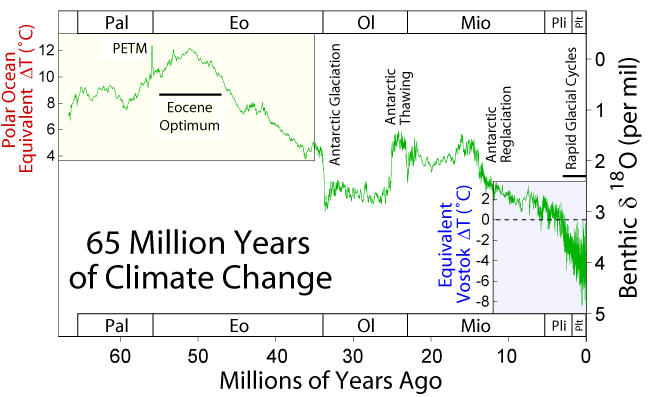 So,
what happened 50 million years ago? A sophisticated proxy of the
temperature at that time (an indirect index recorded in the ratio of
isotopes of oxygen and carbon) reveals that there was a dramatic
increase in global temperatures, as much as 12-15º
C. Alaska was tropical, and hosted crocodiles. At a certain point,
early on in this temperature crescendo, 3000 million tons of methane
hydrate, frozen on the sea floor, suddenly melted, and the global
average temperature spiked for 200,000 years. There were no polar or
mountain icecaps anywhere on Earth, and ocean levels were very much
higher than they are now. Not only that, but ocean currents actually
appear to have reversed direction for about 40,000 years. Suffice it
to say, the Earth of the Eocene Optimum would seem like an alien
world to today's humanity.
So,
what happened 50 million years ago? A sophisticated proxy of the
temperature at that time (an indirect index recorded in the ratio of
isotopes of oxygen and carbon) reveals that there was a dramatic
increase in global temperatures, as much as 12-15º
C. Alaska was tropical, and hosted crocodiles. At a certain point,
early on in this temperature crescendo, 3000 million tons of methane
hydrate, frozen on the sea floor, suddenly melted, and the global
average temperature spiked for 200,000 years. There were no polar or
mountain icecaps anywhere on Earth, and ocean levels were very much
higher than they are now. Not only that, but ocean currents actually
appear to have reversed direction for about 40,000 years. Suffice it
to say, the Earth of the Eocene Optimum would seem like an alien
world to today's humanity.
Our
contemporary carbon pollution of the atmosphere is occurring at
roughly 5 times the rate that created the Eocene Optimum. The ocean
is already more acidic from industrial carbon dioxide than it ever
was in the Eocene.
We
begin to have some sense of the scale of the energy imbalance that we
are engendering. Strangely enough, somewhere between 1/3 and 2/3 of
that 3 W/m2
imbalance that we are forcing with greenhouse gas emissions is masked
by reflective aerosols that we are simultaneously emitting as
industrial pollution – aerosols that block sunlight, and therefore
artificially cool the planet. As we tighten regulations on other
pollutants, like sulfur-oxides, without regulating carbon dioxide
sufficiently, we stand the risk of revealing the true impact of our
contribution to global warming. Because these aerosols are only
suspended in the atmosphere for a short time, if we were to stop
emitting aerosols completely today, within a few weeks or months, we
could see the net energy imbalance of the planet double – and that
would be catastrophic.
There
is one thing worth mentioning, as well. In the time it takes to
equilibrate an energy imbalance, other reinforcing feedback loops can
be triggered which cause the balance point to shift, and the new
forcing factor may not be something we can control. For instance, we
certainly don't have any way currently to keep 5,000 million tons of
methane hydrates from melting on the sea floor, if they start to do
so en masse. There are indications that we have so far overlooked
certain potential feedback loops that could have very significant
impact on the scale of global warming. So far, for example, the
Earth's landmasses have continued to absorb CO2
at the same proportion, year after year, even though the total load
of CO2
output into the environment from human industry has been increasing.
No one thinks that this surprising pattern can persist indefinitely.
In fact, an ongoing study conducted in Colorado, comparing plots of
Earth subject to natural conditions with plots of Earth which have
electric heaters placed over them, reveals that, as temperatures
rise, the soil itself can suddenly switch to become a source of CO2,
rather than a carbon sink. When it does, we can expect that the
release from the soil will yield a doubling of CO2
in the atmosphere.
(Written by Gavain U'Prichard)
Update on the Status of Our Walk
Here is the latest news on what is happening with Pacing the Planet. We've gotten our carts and wagons painted, signs made, Donkeys vaccinated, harness prepared, wagon wheels installed, packing done.
On Monday, September 10, we set out to begin our walk. Egon (10 years old) and I led the two Donkeys (Gemma and Sasha) and our rugged stroller through town and down to the bottom of a steep hill on a gravel lane that would take us most of the 9.5 miles to our first destination, a camp-out at Sever Lake in our Knox County. About a half-hour later, Dana, Simon (4 years old), Tillwyn (15 months old), and another helper appeared at the top of the hill with our pony cart and larger wagon. We call the latter the "Pacing Wagon," and the former the "350 cart," because the pony cart is painted to advertise the social movement for bringing atmospheric concentration of carbon dioxide back down to 350 parts per million. That movement is spearheaded online at the website www.350.org.
After carefully walking the (rather heavy) carts down the gravel hill, we got Gemma in her harness, and hitched her up to the 350 cart, and I started leading her down the road. This was her second time in harness and pulling the cart. Egon was leading Sasha, and pushing the stroller at the same time. Dana started out by pulling the Pacing Wagon, rickshaw style. So far, so good. The only challenge was that the donkeys were unexpectedly skittish of the sound the wagon wheels make when moving on gravel, so Egon and I had to walk them several hundred yards ahead of the Pacing Wagon.
Around the first corner, our troubles began. Egon was having a challenging time leading Sasha and pushing the stroller simultaneously. Gemma is very good at peacefully towing the 350 cart, but gets impatient when just standing still in the traces. And Dana was falling behind.
The road was just freshly laid with large gravel, and the large (but narrow) wheels of the Pacing Wagon were digging into the rocks as if it were slush. Dana was starting to see stars from the exertion. She and I switched places, and while she led Gemma, I tried my hand at pulling the Pacing Wagon, which was heavier than I had expected, once we had it all packed up. It was very slow, hard going for me, too; a passerby in a car informed us that the entire way to the town of Hurdland, MO, had received new gravel: about 7 miles. We had walked maybe a half-mile so far. Dana was hungry and not feeling well, so we found a tiny bit of shade, and made peanut butter and jelly sandwiches. In the meantime, a gigantic harvester which had come to cut down the cornfield next to us on the road, began making slow passes through the field, sending a shower of dust and corn-stalk fragments billowing around us. We decided that we needed to make some different preparations, called for help, and, about an hour later, got every vehicle, animal, child, and adult back to our house. We felt worn out and morose.
Since then, we have revised some logistical details, and are making preparation for our next attempt within a week, should our newly-ordered supplies arrive. For one thing, we will be sticking to paved roads now, or else, well-packed roads scouted in advance. We will be attaching the stroller (which coverts to a bicycle trailer) to the back of the 350 cart, or not taking it at all. We have ordered a pack-saddle for Sasha, and she will be able to lighten the load of the Pacing Wagon in that way. We've also decided to bring a second tent, and got some warmer sleeping bags, and such items. After all, cooler fall weather is descending rapidly (though, as you hopefully understand, these normal seasonal variations in the weather don't contradict the overall pattern of global warming an climate change).
Probably the biggest change to Pacing the Planet is the formulation of a tighter strategy to our presentations and meetings, at least for this autumn. In the course of our research, reading, and conversations with other presenters on climate research, a clear direction for the first steps in restoring climate balance has come to our attention.
In the eight years (and very possibly as little as five years) that humanity has left to change course on our pollution of the atmosphere with CO2, the obvious necessary step is that we must shut down the coal industry. Coal still provides an unfortunately large proportion of our constant energy source in the U.S.A., and the data is clear that if humanity continues to extract and use coal, then the colossal impact of the carbon load in the atmosphere from that one source alone means that all the "going green," alternative energy, efficiency improvement, and rationing of other greenhouse gas sources won't make enough of a difference to offset the damage done by coal. In other words, coal burning, by itself, will drive us into catastrophic climate change.
So, coal has got to stay in the ground. We need to do this not only for our own responsibility, but to be in a position to credibly leverage China, Russia, and Saudi Arabia to keep their fossil fuel sources in the ground, too. In 2011, China was launching a new coal-powered energy plant every month.
 A common question we've fielded, as we start to talk to people, is this: if making improvements in our personal lives ("going green") is not enough, what can we do? Shutting down coal is a goal that we can rally around, a clear community effort, and provides a measure of how serious our politicians are about addressing this problem fundamentally, before it is too late (if it is not, already). Even if we're already committed to very bad climate change, we need to stop using coal, so we don't trigger the sudden release of methane hydrates in the ocean, which will likely spike global temperatures to a level last seen during the major extinction event 50 million years ago. That spike, if history is anything to go by, could likely last for 100,000 years. Continuing to burn coal into the 2030s will almost certainly bring us to that point).
As it turns out, the Midwest, and particularly, Missouri, Iowa, and Illinois (what the locals call the "tri-state area") is one of the areas most heavily invested in coal extraction and burning. If you looked at the interactive map that I linked to in my last post, you will see that we are surrounded by coal plants and coal mines, within a 150 mile radius. If you pay attention to politics, you are probably also aware that Iowa is a key swing state in the upcoming presidential election, and that Missouri could come into play: partly thanks to Todd Akin's incredible, unintentional revelation of the logic behind the GOP's anti-abortion platform plank, and partly (we hope) if young people in Missouri are made aware of the coal fiasco surrounding them, its relation to this year's devastating drought, and what "business as usual" means for the future of the Midwest.
Therefore, we will be Pacing the Planet in Missouri and Iowa this fall -- and particularly, heading to colleges and universities, where we will be giving presentations on the science, the situation. We want to help young student activists understand the importance of Mitt Romney's campaign embracing a future in coal (not to mention supporting the disastrous development of Canada's bituminous sands oil industry). We're already working on establishing connection with our local Truman State University in Kirksville, MO, as well as the University of Missouri in Columbia (whose Atmospheric Science program is chaired by a notable oil-associated "skeptic" of human-caused global warming). We have our sights on the University of Iowa in Iowa City, as well.
Of course, we are still walking to do something different than the day-to-day routine, to highlight that we can't continue our individual day-to-days, and expect technology or experts to fix this problem for us. They won't, and we will die (and so will a lot of life on Earth) if we continue. We walk because, somehow, walking helps us embody the immense geological time-frames upon which the consequences of our actions now will play out (though the consequences are already starting, and will rapidly worsen, if we do nothing). Walking also helps our imaginations embrace the very different visions of Earth that the past serves up as examples of what our world will look and feel like, as we try to picture change on that scale, with that suffusion into our entire experience.
So, friends, we need more people to walk with us. If you can join us this autumn in Missouri and Iowa, please do! Also, please support our fundraising campaign as much as you can, and pass word of it along to your mailing lists and your contacts. We are so grateful not to be the only ones concerned about this turning point in our dear planet's history, and so grateful for the help and love that have been pledged so far. Please know that, although our departure date has changed, our resolve to walk has not wavered, nor has our enthusiasm and passion to do so. As our vision has expanded, preparations and supplies have been more expensive than we originally budgeted, so we can use all the help you can send. And, we're already at 34 percent! Yeah!
On Monday, September 10, we set out to begin our walk. Egon (10 years old) and I led the two Donkeys (Gemma and Sasha) and our rugged stroller through town and down to the bottom of a steep hill on a gravel lane that would take us most of the 9.5 miles to our first destination, a camp-out at Sever Lake in our Knox County. About a half-hour later, Dana, Simon (4 years old), Tillwyn (15 months old), and another helper appeared at the top of the hill with our pony cart and larger wagon. We call the latter the "Pacing Wagon," and the former the "350 cart," because the pony cart is painted to advertise the social movement for bringing atmospheric concentration of carbon dioxide back down to 350 parts per million. That movement is spearheaded online at the website www.350.org.
After carefully walking the (rather heavy) carts down the gravel hill, we got Gemma in her harness, and hitched her up to the 350 cart, and I started leading her down the road. This was her second time in harness and pulling the cart. Egon was leading Sasha, and pushing the stroller at the same time. Dana started out by pulling the Pacing Wagon, rickshaw style. So far, so good. The only challenge was that the donkeys were unexpectedly skittish of the sound the wagon wheels make when moving on gravel, so Egon and I had to walk them several hundred yards ahead of the Pacing Wagon.
Around the first corner, our troubles began. Egon was having a challenging time leading Sasha and pushing the stroller simultaneously. Gemma is very good at peacefully towing the 350 cart, but gets impatient when just standing still in the traces. And Dana was falling behind.
The road was just freshly laid with large gravel, and the large (but narrow) wheels of the Pacing Wagon were digging into the rocks as if it were slush. Dana was starting to see stars from the exertion. She and I switched places, and while she led Gemma, I tried my hand at pulling the Pacing Wagon, which was heavier than I had expected, once we had it all packed up. It was very slow, hard going for me, too; a passerby in a car informed us that the entire way to the town of Hurdland, MO, had received new gravel: about 7 miles. We had walked maybe a half-mile so far. Dana was hungry and not feeling well, so we found a tiny bit of shade, and made peanut butter and jelly sandwiches. In the meantime, a gigantic harvester which had come to cut down the cornfield next to us on the road, began making slow passes through the field, sending a shower of dust and corn-stalk fragments billowing around us. We decided that we needed to make some different preparations, called for help, and, about an hour later, got every vehicle, animal, child, and adult back to our house. We felt worn out and morose.
Since then, we have revised some logistical details, and are making preparation for our next attempt within a week, should our newly-ordered supplies arrive. For one thing, we will be sticking to paved roads now, or else, well-packed roads scouted in advance. We will be attaching the stroller (which coverts to a bicycle trailer) to the back of the 350 cart, or not taking it at all. We have ordered a pack-saddle for Sasha, and she will be able to lighten the load of the Pacing Wagon in that way. We've also decided to bring a second tent, and got some warmer sleeping bags, and such items. After all, cooler fall weather is descending rapidly (though, as you hopefully understand, these normal seasonal variations in the weather don't contradict the overall pattern of global warming an climate change).
Probably the biggest change to Pacing the Planet is the formulation of a tighter strategy to our presentations and meetings, at least for this autumn. In the course of our research, reading, and conversations with other presenters on climate research, a clear direction for the first steps in restoring climate balance has come to our attention.
In the eight years (and very possibly as little as five years) that humanity has left to change course on our pollution of the atmosphere with CO2, the obvious necessary step is that we must shut down the coal industry. Coal still provides an unfortunately large proportion of our constant energy source in the U.S.A., and the data is clear that if humanity continues to extract and use coal, then the colossal impact of the carbon load in the atmosphere from that one source alone means that all the "going green," alternative energy, efficiency improvement, and rationing of other greenhouse gas sources won't make enough of a difference to offset the damage done by coal. In other words, coal burning, by itself, will drive us into catastrophic climate change.
So, coal has got to stay in the ground. We need to do this not only for our own responsibility, but to be in a position to credibly leverage China, Russia, and Saudi Arabia to keep their fossil fuel sources in the ground, too. In 2011, China was launching a new coal-powered energy plant every month.
 A common question we've fielded, as we start to talk to people, is this: if making improvements in our personal lives ("going green") is not enough, what can we do? Shutting down coal is a goal that we can rally around, a clear community effort, and provides a measure of how serious our politicians are about addressing this problem fundamentally, before it is too late (if it is not, already). Even if we're already committed to very bad climate change, we need to stop using coal, so we don't trigger the sudden release of methane hydrates in the ocean, which will likely spike global temperatures to a level last seen during the major extinction event 50 million years ago. That spike, if history is anything to go by, could likely last for 100,000 years. Continuing to burn coal into the 2030s will almost certainly bring us to that point).
As it turns out, the Midwest, and particularly, Missouri, Iowa, and Illinois (what the locals call the "tri-state area") is one of the areas most heavily invested in coal extraction and burning. If you looked at the interactive map that I linked to in my last post, you will see that we are surrounded by coal plants and coal mines, within a 150 mile radius. If you pay attention to politics, you are probably also aware that Iowa is a key swing state in the upcoming presidential election, and that Missouri could come into play: partly thanks to Todd Akin's incredible, unintentional revelation of the logic behind the GOP's anti-abortion platform plank, and partly (we hope) if young people in Missouri are made aware of the coal fiasco surrounding them, its relation to this year's devastating drought, and what "business as usual" means for the future of the Midwest.
Therefore, we will be Pacing the Planet in Missouri and Iowa this fall -- and particularly, heading to colleges and universities, where we will be giving presentations on the science, the situation. We want to help young student activists understand the importance of Mitt Romney's campaign embracing a future in coal (not to mention supporting the disastrous development of Canada's bituminous sands oil industry). We're already working on establishing connection with our local Truman State University in Kirksville, MO, as well as the University of Missouri in Columbia (whose Atmospheric Science program is chaired by a notable oil-associated "skeptic" of human-caused global warming). We have our sights on the University of Iowa in Iowa City, as well.
Of course, we are still walking to do something different than the day-to-day routine, to highlight that we can't continue our individual day-to-days, and expect technology or experts to fix this problem for us. They won't, and we will die (and so will a lot of life on Earth) if we continue. We walk because, somehow, walking helps us embody the immense geological time-frames upon which the consequences of our actions now will play out (though the consequences are already starting, and will rapidly worsen, if we do nothing). Walking also helps our imaginations embrace the very different visions of Earth that the past serves up as examples of what our world will look and feel like, as we try to picture change on that scale, with that suffusion into our entire experience.
So, friends, we need more people to walk with us. If you can join us this autumn in Missouri and Iowa, please do! Also, please support our fundraising campaign as much as you can, and pass word of it along to your mailing lists and your contacts. We are so grateful not to be the only ones concerned about this turning point in our dear planet's history, and so grateful for the help and love that have been pledged so far. Please know that, although our departure date has changed, our resolve to walk has not wavered, nor has our enthusiasm and passion to do so. As our vision has expanded, preparations and supplies have been more expensive than we originally budgeted, so we can use all the help you can send. And, we're already at 34 percent! Yeah!
A Valuable Resource
Here is an interactive map, courtesy of the World Resources Institute, that gives detailed information to those of us in the U.S. Midwest about where and how our electricity is being generated, and what is the environmental consequence of those actions. Unfortunately, as you will see, much of the Midwest is still getting its electricity from burning coal.
Power Almanac of the American Midwest (map)
Coal is the number one source of anthropogenic carbon-dioxide, as well as being a major source of mercury pollution, acid rain production, and water-contamination in the area where it is being extracted.
Coal is responsible for about 100,000 deaths per year (that's a conservative measurement). By comparison, Chernobyl, a poorly designed nuclear reactor, caused about 4,000 deaths when it exploded. So-called "slow" reactors do create many toxic by-products with a half-life of thousands of years. However, "fast" reactors can have a 90%+ efficiency (as opposed to the 1% efficiency of "slow" reactors), and therefore create much less radioactive waste, and that waste has a half-life of a few-hundred years, as opposed to millennia.
It is time to reconsider nuclear power (at least on a temporary basis), if we are to immediately end the use of coal as a base source of continuous power in the next few years. Coal, if we continue to use it, will most certainly carry us into the dangerous world of extreme climate fluctuation.
(Written by Gavain U'Prichard)
Power Almanac of the American Midwest (map)
Coal is the number one source of anthropogenic carbon-dioxide, as well as being a major source of mercury pollution, acid rain production, and water-contamination in the area where it is being extracted.
Coal is responsible for about 100,000 deaths per year (that's a conservative measurement). By comparison, Chernobyl, a poorly designed nuclear reactor, caused about 4,000 deaths when it exploded. So-called "slow" reactors do create many toxic by-products with a half-life of thousands of years. However, "fast" reactors can have a 90%+ efficiency (as opposed to the 1% efficiency of "slow" reactors), and therefore create much less radioactive waste, and that waste has a half-life of a few-hundred years, as opposed to millennia.
It is time to reconsider nuclear power (at least on a temporary basis), if we are to immediately end the use of coal as a base source of continuous power in the next few years. Coal, if we continue to use it, will most certainly carry us into the dangerous world of extreme climate fluctuation.
(Written by Gavain U'Prichard)
A Perspective Money Can't Buy

We
are developing a Cassandra Complex, we who chime into silence about
what we ought to call the Climate Catastrophe. I suppose humans are not
biologically programmed to respond urgently to a threat that seems
distant. Behind the scenes, the scientists studying our Earth's patterns
rapidly revise the outlook in the direction of more severity, and
quicker consequence. They are dismayed, surprised, in awe of the
snowballing effect. Mark you this: not one -- not one -- study that
we've found, in a review of literature from the last four years, has
indicated a serendipitous mitigating influence previously undiscovered.
All the new discoveries are painting a scene increasingly grave. Like
blind men, the scientists have been groping what they thought was the
unseen elephant not discussed in our national conversation; what they
found they had hold of was rather a dragon.
Indefinite
proposals about cleaner energy in the future are not enough. 54
miles-per-gallon vehicles in 2025 is not enough. It is a start; but, by
then, we will have sailed far out into the sea of our own peril.
In
the absence of answers to my open letter (see below), I am left to
muse. Modern people are subject to a back-breaking load of cynical
realism. We convince ourselves that there is no hope, and we forget the
unfathomable successes that people have accomplished in the past. Since
our government is beset by greed and corruption, and bought out by
groups who care, each, about their one thing, and only that one thing,
we are unsure what it feels like to take a common action, to agree on something.
In
short, we have lost perspective of our life here on Earth. We have the
equivalent of a major asteroid heading on a collision course with Earth
(as one well-known climatologist put it), yet, instead of being
discussed in every living room, barbershop, supermarket, and deli, not
to mention the halls of government, only the most dramatic developments
-- like the record loss of arctic sea ice this year -- get briefly
reported. We are muffled in the soft, suffocating grip of human affairs.
Let's
step back a bit. When was the last time you looked at the sky? I mean,
really considered it, not just glanced upward and gave the names of what
you saw: sun, clouds, moon, stars, blue, blue, blue.

When
you stare into the blue, you are looking about 370 miles of atmosphere.
A bright object, such as the daytime moon, can be seen, even though it
is 225,000 miles away. As night falls, of course, you can see much
further: generally, about 17,010,518,400,000,000,000 miles out into
space, and 2.9 million years into the past. Compare this with the
approximately 100 miles that you can see, in the clearest conditions,
looking to the horizon on Earth (on a very open plain), and we might
suppose that upwards is where we will look if we really want to get a
handle on our lives, find the vantage point from which we can see our
existence in context. Indeed, our ancestors, without artificial
lighting, did interact with the ocean of the Universe as directly as
they fished in the earthbound sea.
But,
we moderns are fixated on life, on the terrestrial sphere. Actually, we
are indoors most of the time. The EPA estimates that a typical American
adult spends 90% of her time inside buildings, and, this year, the
Nature Conservancy reported that as little as 10% of American children
describe themselves as spending time outdoors every day. The main
deterrents to enjoying nature? Heat and bugs. When it comes to
considering stars and galaxies, most of us seem to regard them as an
exravagant celestial wallpaper, less relevant to our daily lives (even
though we are starting to realize how truly odd the whole Universe is)
than our ancestors considered them to be (though they believed the
starry heaven to be unchanging).

This
is true of our thinking about our own sun. For one thing, we’re not
supposed to look directly at it. This keeps our gaze level with the
ground, and it also makes us compartmentalize our knowing of the sun. On
a clear day, for instance, we will note that “it” is hot, that the day
is “sunny;” but when was the last time you completely considered the sun
for what it is: an enormous star, one million times the volume of the
Earth -- a thermonuclear reactor sending a tidal wave of energy out
through the solar system, washing over the Earth every single second.
The only thing protecting us from roasting under the eye of the sun (and
freezing to death in the dark night of near-absolute-zero temperatures),
the one thing, is Earth’s atmosphere.
The
atmosphere is an absurdly thin veil, comparable to the peel of an
apple, and it is a mere one-percent of that atmosphere that creates the
Greenhouse Effect which makes our existence possible. These gases
constitute less of the air than does O2
that we breathe into our blood, itself only 16% of the atmosphere. It
is not surprising, then, when we consider that we are dumping 100 times
the amount of carbon-dioxide into the air every year than do all the
active volcanoes on Earth, that we can really change the characteristics
of that one-percent of the atmosphere. It is a real game of chicken
that we are playing. The sun is a massive entity, storming our shores at
every moment. We are only lucky that our shelter has been so secure up
until now.
Let’s
take a further step back, however, and really survey the situation.
What, after all, are we who challenge humanity to do something about
climate change fighting for? In the future, several incredible events
will unfold. About 600 million years from now, the sun will have
appreciably increased its radiation, accelerating the weathering of
silica rock formations, which will lead to a dramatic decrease in
carbon-dioxide in the atmosphere -- to the point that most plant life
(and therefore, most animal life) will be unable to survive. Even later,
the Earth’s axis of rotation will begin to wobble chaotically,
sometimes pointing the north or south pole straight at the sun for
millions of years. This, too, will wildly upset what climate and habitat
zones remain on Earth.

Finally,
in a bit more than 1 billion years, the sun will have increased its
radiance by 10% or so, and this is expected to trigger a runaway
greenhouse-effect, due, this time, to water vapor, such that the oceans
evaporate totally into space. The Earth will then endure as a dry sphere
of stone and metal, until some 7.5 billion years from now, the sun, now
expanding into a star form called a “red giant,” engulfs our planet
within its corona, vaporizing it.
So,
what is the point of forestalling environmental ruin at this point?
Knowing what we reasonably predict about the future of the Earth and the
sun, and the unlikelihood of our being able to do anything to
successfully change that outcome,
why not leave the party early? We are triggering an early round of
catastrophic global warming, but we’re not “out-of-line,” ethically,
with the big picture, are we?
Well, first of all, there are, in
fact, methods being designed, on the occasional sleepy Sunday
afternoon, for moving the planet out of harm’s way from the sun.
However, that is not the reason to fight 21st century climate change.
People
sometimes deride environmentalists as trying to keep things precious
and perfect forever -- in other words, failing to embrace change. But,
that is not in the cards, and not the point. The reason to save life on
Earth now is that we’re only halfway done. 600 million years is also
about the amount of time that life has significantly populated the
planet. There is a quality to life on Earth that is more important than
its longevity, and that is its intricacy.
The intricate weave of life, intelligence, and communication on Earth is what makes it possible for us to have a
long perspective, to appreciate Deep Time, even though humanity has
only existed for a tiny beat of the geological record. What Buddhists
call the co-dependent arising of reality on Earth is only in midstroke, a
magical creation, and we are not yet in a position to evaluate its importance.
There is, in short, so much going
on here. It is a typically human attitude to both assume that we have
the index on the complexity of the orchestration, and also that the
significance of this symphony exists (if it does) somewhere in the
future. Our planet is bleeding off a signal of life into space, and
perhaps into the structure and the meaning of the Universe itself. If
we’re going to shut down the transmitter, if we are going to kill the
oceans and drive the lands into drought and make the storms unforgiving,
if we’re going to bring hell to Earth, let’s be damn sure we’re doing
it for a better reason than our forgetting to look up.
Seeking legal representation
As we count down the final days before we embark on our walk to raise awareness of climate change, we are lining up many logistical details to ensure that we have the safest and most effective journey that we can plan, especially for our three children who are joining us.
Our action plan so far is entirely within the realm of education and advocating preparedness. We do not intend, at this time, to engage in unlawful civil disobedience.
Nonetheless, not every person that we encounter may necessarily feel comfortable with our endeavor, nor with our children's involvement. For these reasons, we are seeking to secure, in advance of our walk, pro bono legal representation for our family, so that we can be prepared, should we meet unexpected legal or law-enforcement resistance to our action.
If you know of a pro bono legal service or individual lawyer who would be qualified to represent us in the jurisdictions where we will be walking, please let us know. We would also appreciate references to anyone who can help guide us in this matter, even if they are not qualified to represent us.
For the first two months, our intended route will take us into Iowa, Missouri, Kansas, Oklahoma, and Texas.
Pacing the Planet will, to the best of our ability, follow a pre-planned route, be supported by known contacts with lodging and supplies for us. We will be following the Rules of the Road, obeying traffic laws etc. However, we want to be prepared if law enforcement attempts to bully us with threats of child endangerment charges, or some other charge related to negligence.
If you can help, please let us know!
Our action plan so far is entirely within the realm of education and advocating preparedness. We do not intend, at this time, to engage in unlawful civil disobedience.
Nonetheless, not every person that we encounter may necessarily feel comfortable with our endeavor, nor with our children's involvement. For these reasons, we are seeking to secure, in advance of our walk, pro bono legal representation for our family, so that we can be prepared, should we meet unexpected legal or law-enforcement resistance to our action.
If you know of a pro bono legal service or individual lawyer who would be qualified to represent us in the jurisdictions where we will be walking, please let us know. We would also appreciate references to anyone who can help guide us in this matter, even if they are not qualified to represent us.
For the first two months, our intended route will take us into Iowa, Missouri, Kansas, Oklahoma, and Texas.
Pacing the Planet will, to the best of our ability, follow a pre-planned route, be supported by known contacts with lodging and supplies for us. We will be following the Rules of the Road, obeying traffic laws etc. However, we want to be prepared if law enforcement attempts to bully us with threats of child endangerment charges, or some other charge related to negligence.
If you can help, please let us know!
...because I really want to be "Granny," someday...

And the internet is down, I find. So I've opened up the virtual notepad to get some of these thoughts onto "paper" and, hopefully, out of my head for tonight!
Now I've just heard a sound outside...it sounded like someone moving our metal garden wagon...a quiet clanging of the handle being let back onto the siderail. If that is being caused by a human, it would indicate a strong likelihood that someone has entered our yard through the unlocked front gate, and penetrated the open door of our twenty-foot yurt-dome tent which we use for a bike shed and storage garage for tools and yard stuff. We have nice road bikes in there, which we've fixed up to be able to be our primary form of transport here at home. Trailers, Trailabikes, a whole large-families-worth of bicycle fun with reasonable theft-value, for people who would so pursue resell-able items.
I keep hearing noises. Now in the bathroom. Are the cats super active right now?! The geese just honked, down in the yard. Three and a half thousand years ago, geese honking alarm in the middle of the night saved Rome from their enemies sneaking up in the darkness.
But I do not have any personal enemies, and if someone is compelled, on this night, to steal from our dome, I think I'm entirely prepared to accept it. That means that I'm probably not going to run outside in my t-shirt and panties, screaming like a banshee, pulling up my shirt and yelling "WATCH OUT FOR BOOBIE TRAPS!" We'll see, I have that plan in reserve, if I change my mind.
Allow me to speak metaphorically for a while, if you will.
I do have enemies, though, because I am a conscious figment of God. I know the wonder of God, and I know that I am the wonder of God, as are my children, and the cats and geese, and the thief in the dome. Even my enemies are broken-off crystal shards, who have been violently separated from their larger sacred crystaline origin.
My enemies have taken a position of opposition to humanity, as well as to all of the life forms on our planet. I, being a whole and passionately inspired human animal, will never abide their agenda. Like predator and prey, we are natural enemies. If I stood aside in complacency, tolerating rape and plunder, I would be in basic denial of my natural purpose. I will fight to the death for beauty and truth, and for the right of my children to live and to love. I will fight to the death against the fate my enemies have been arranging for my children.
Though it seems logically probable that I will lose the fight, and watch my children, as teenagers perhaps, die from critical lack of water or food. I will know, in that event, that I have done everything I could think to do to create alternative systems and cultural shifts: I have undertaken countless personal transformations, rising to meet my own sacred wisdom, and leveling up to new heights of personal power...translating my power into action at every noticed opportunity. Knowing that I did everything I could to preserve their lives and freedoms, I will be prepared to accept their deaths.
Truly, that is my family's trajectory, and we are heading there fast. And if you aren't yet aware, I bear to you the unpleasant news that your family is facing the same medium-term future. As we are the makeup of humanity -- the most conscious and widely capable animals on this planet -- we have these enemies in common. And I'm wondering if you will help me to resist them.
The enemies are individuals who have "sold their soul," or who have sacrificed their love and devotion to truth on the altar of greed, and in the pursuit of power. They have also sold the lives and freedom of countless humans, creating foreign wars and playing our brethren soldiers as pawns. Bless the poor soldiers' souls, whose lives were sacrificed for the greed of Capitalistic domination!
I accept that they have become my enemy. I do not mean them any fundamental harm as individual godlettes, but I will stand over their dead bodies, if necessary, with the clear conscience of a conscious human warrior.
When our enemies sold their souls, or, when they turned to the dark side (choose any analogy that makes sense to you), they, too, were knowingly accepting this relationship with us. For, they know in their deepest hearts their own origin in the magnificence of love and perfection (as we all do), and so they also know, in that core place within, that they have become traitors to God, to the whole of life.
The enemies have taken over our economic and governmental systems. That is to say, they are at the heads of the largest corporate entities on our planet, the fossil fuel industry, and they have politicked and maneuvered their dollars, so that they are also "wearing the pants" in our government.
Their systems are built on exploitation, and they shamelessly scour the earth overturning mountains in search of another virgin pocket of nature to rape. The sacred people of other lands are accepted by our enemy as having only as much value as their existence can contribute to the profit of the corporations. Many of the world's people are hungry and desperate, but our incomprehensibly rich enemies do not opt to uplift them. Rather, they "capitalize".
But, if you ask me, the most sinful thing that our enemy does is that they lie. They use their god-given endowments of charisma and intelligence, or in many cases, just employ the basic human capacity to build a skill, and they learn how to use words to twist reality to their will. To defeat our awareness of their nature and the ramifications of their agenda, they design doubt-instilling propaganda and pay for the psychological onslaught of advertisements and media coverage of their brain-washing material.
I do not exaggerate, you must know. They have literature and private workshops which have helped them to learn effective ways to use language to dupe the masses and for the most part, we are standing, stupefied. We know something is not right, but we can't quite pin down the source of evil, and we are not able to track the speed of the card tricks. In many cases, we are head down, contributing our strength and leaning our weight into the mechanism of their evil machinery.
We are, then, the unknowing "useful idiots" (that is their term, not mine) propelling the thriving of our own enemies, yet convinced that we are doing the best that we can for our own families, bringing home the paycheck. Many of us have not yet developed the discernment to recognize on sight the difference between the dark side and the light. And most of us surrender that assessment, sheep that we are, opting to shuffle with the herd, unsure where we are being led, but trusting that it is safer and wiser to stay with the pack.
I do not exaggerate, you must know. They have literature and private workshops which have helped them to learn effective ways to use language to dupe the masses and for the most part, we are standing, stupefied. We know something is not right, but we can't quite pin down the source of evil, and we are not able to track the speed of the card tricks. In many cases, we are head down, contributing our strength and leaning our weight into the mechanism of their evil machinery.
We are, then, the unknowing "useful idiots" (that is their term, not mine) propelling the thriving of our own enemies, yet convinced that we are doing the best that we can for our own families, bringing home the paycheck. Many of us have not yet developed the discernment to recognize on sight the difference between the dark side and the light. And most of us surrender that assessment, sheep that we are, opting to shuffle with the herd, unsure where we are being led, but trusting that it is safer and wiser to stay with the pack.
That is why I say that we will probably fail to defeat our enemy. And though am doing everything that I can do to know that I have done my part to rescue my children's world, I will fail without your help.
We may look into each others' eyes as we die together, in twenty or fifty years, from the hyper-extreme temperatures and impossible weather patterns which are just beginning their fast track to overwhelming the ingenuity of man... Though we may share a final moment of mutual appreciation and gratitude, I wonder if we couldn't just cut to the chase, and reclaim our sense of wonder now.
It is so clear to me, as it is to many people who are already fully invested in this movement to restore the will of good to our species and salvage some balance in the systems of nature, that we need many thousands more people to join our fight if we are to have any real chance in this. Geologically, this is the very last split second in which we might choose as a species to alter our behaviors enough to divert our collision course with destruction.
We have five years in which to make these profound changes and after that time we will know our fate, beyond a doubt. There is so much man-made carbon dioxide in our atmosphere, and of course, we continue to pump up increasing tons of it every year, that our planet has become covered by a smothering blanket -- excess heat can no longer escape quickly enough. The life forms (including my yet-unborn child) which have, over the course of millions of years, genetically adapted to this world, will no longer be welcome here. Burned or drowned, homeless, without drinkable water, or without food, we will all die.
We have five years in which to make these profound changes and after that time we will know our fate, beyond a doubt. There is so much man-made carbon dioxide in our atmosphere, and of course, we continue to pump up increasing tons of it every year, that our planet has become covered by a smothering blanket -- excess heat can no longer escape quickly enough. The life forms (including my yet-unborn child) which have, over the course of millions of years, genetically adapted to this world, will no longer be welcome here. Burned or drowned, homeless, without drinkable water, or without food, we will all die.
Yes, even our enemies will be dying with us in these yonder days. Though they may pay worthless pawns to build fancy bubbles for the richest of them to live in for some period, extending their lifespan beyond ours a short distance, the destruction which they have wrought will necessarily take them down too. Because, that is how insane is is going to get here.
Or, maybe we should stop them?
(written by Dana)
Subscribe to:
Posts (Atom)