The Need to Take Risks

I saw the trailer for a new film today. The movie is called Chasing Ice. A team of scientists, photographers, and adventurists set out to create the most complete catalog of photographic documentation of retreating ice -- no, let me rephrase that -- of ice-sheet collapse that has yet existed. According to the project, James Balog created the Extreme Ice Survey in 2005 (with cooperation from National Geographic), and Chasing Ice is a documentary of his team's efforts to place revolutionary time-lapse photography cameras across the Arctic, in some of the most taxing conditions found on Earth, to image the vanishing of the northern glaciers.

I found the trailer riveting, in the same way that people in the first two decades of the 20th century found Sir Walter Scott's and Sir Ernest Shackleton's polar expeditions unforgettable. But there is more to it than that. Scott and Shackleton found the poles to be dangerous, of course -- but they were natural dangers. The trailer for Chasing Ice emphasizes that Balog and his team endure extremely risky conditions for a different reason: the whole environment is in an uproar, a massive shift brought on by our destabilizing of the climate. They put themselves on the very brink, the treacherous leading edge of the climate catastrophe, in order to capture photographic evidence that will indisputably point to our involvement with its causation, that will illustrate the scale and the severity of the change.

I am mindful of this, as we who are doing Pacing the Planet formulate our next steps. Our biggest risks faced so far are big trucks on narrow country lanes, the scorn of some passers-by, and the threat of running out of money while trying to do "the right thing." There is a palpable force trying to get us back in line, do the expected, perform our function, get small again.

That force is the collective disdain, the opprobrium, and -- ultimately -- the indifference of people at large to our situation, as we refuse to divert our attention from the emergency. We're not doing what we're supposed to do (according to our society), so we're starting to fall through the cracks. We're not earning money, we're not talking about the same things everyone else is talking about (like the economy), so we're fringe. It feels like we're being forgotten. In public forums, some people have questioned our sanity. Heck, some family members have questioned our sanity.

I admit that a small, angry part of me wants to believe that the obvious importance of what is at stake with climate change will rally the support of anyone who has ever known us, who even remotely cares about us, to lead our own bit part of the charge. "Don't worry!" the unseen chorus says in my hopeful ear. "We'll take care of the bills. (They are small). We'll provide the operating budget for Pacing the Planet, be the breath beneath the wings of the project and help it take flight!" Understand that I am so appreciative of the people who are supporting our first fundraising campaign, but I have to tell you that what the chorus whispers in my ear remains a fantasy for now. Not only do we need to succeed in our fundraising effort, but we need to generate a lot of support, to push the emergency front-and-center in the collective attention of humanity within the next four years. This is our job now. Not just money, you see, but people, too. A movement. (That is why we are going to Chicago on November 28, to participate in the "Do the Math Tour" sponsored by 350.org and Bill McKibben, so we can start working in parallel with others. 350.org has also invited us to provide a guest blog entry on their website...look for it soon!)

Then comes Chasing Ice. And I realize, we are not risking enough, yet. We must go bolder, be as wildly daring and creative as the Earth which is fomenting this change upon us. The surprising lack of concern among even those we've known directly in the past isn't personal to us. Somehow, global warming and climate change are not registering viscerally as a threat to our very existence. There is an apocalypse of zombie-like denial out there. What we need are a few, startling images that stir the reflex of disgust and shock, that provoke people to exclaim: "This cannot be!" Balog and his crew are risking their lives to bring those sorts of images. They will not be thanked properly until the great host of people on Earth stop in wonder at the vision they have brought before us, and then take action of commensurate sacrifice and willingness to change.

As for our own action, Pacing the Planet, we've only just begun.

A poster for you

Here is a link a downloadable poster that you can print on letter-size paper, and put up in your locality: https://docs.google.com/open?id=0B3iuIfRkjF1nX1lzbXFiSG9rTUU

It is styled after a traditional eye-chart, and looks like this:


Let us know if you are interested in contributing to a mass printing of these in large-poster format. A print run of 1000 would cost about $880. You can also order large-poster prints from Vistaprint.com for $9.73 each.

To our knowledge, there is not yet a public service media campaign to let people know about the startling announcement from the International Energy Agency in November of 2011 -- that we have 5 years (4 years, now) to change course globally with our energy policies, or so much new infrastructure for burning fossil fuels will have been built that we will be committed to irreversible climate change.

You can read about that announcement in the Guardian newspaper.

Clearly, this is a very important message to get out to as many people as possible. Help us convey the urgent time-frame by printing out some posters and putting them up today!

Pacing the Planet -- Update

We had a surprisingly effective and enjoyable walk today (we being: Dana, Gavain, and Tillwyn), weaving our carts in and out of traffic around the town of Kirksville, MO. Kirksville is 25 miles from our house, and is the nearest city with a population greater than 10,000 people. We brought the cart and wagon in by truck today (I'll explain why in just a bit), and paced around the town square, and over to the local super-market, about 1.5 miles away.

We did a bit of shopping in the grocery store, and for the occasion, we strapped a dry-erase board to the front of our cart, which read: "Do you know that a climate catastrophe is underway? Talk to us!" Mostly, for our troubles, we received a bunch of frowns, and some dirty looks, but one kind man did stop us in the parking lot, ask us where we were planning to pace, and wondered if we had yet received any media attention.

Afterwards, we walked our wagon and cart back the 1.5 miles to the square, where we encountered the homecoming parade for the Kirksville school system, just as it was warming up. Two marching bands, majorettes, a fire truck, floats with football players and prehistoric reunions, not to mention cameos by the Adair County Republican and Democratic election committees. We found a suitable spot by the sidelines, where our carts nonetheless drew considerable attention, and we had several valuable conversations about the climate.

At the end, we requested help loading our wagon and cart into the truck from some high schoolers who are volunteering for the Democratic candidate for State Representative of District 3 in Missouri. Dana had a chance to talk just a bit with the candidate herself, Rebecca McClanahan, and share with her about Pacing the Planet, and our concern with global warming. Ms. McClanahan was appreciative and supportive of our project.

We have modified our strategy this fall, so that we will be bringing our carts to special locations in our (soon-to-be) vegetable oil powered pickup truck, and then pace locally at those spots. Part of the reason for the change is that Dana is experiencing some health challenges that have been sapping her energy recently, and we need to take care of her. We also are valuing the practice for a more extensive endeavor in the spring.

Thirdly, we are evaluating our progress working with Jemma and Sasha, the donkeys; we believe that, with some more time for training, we can feel more confident in our relationship with them, and we believe we can train them to walk faster with us. (It is also possible that we will decide that the donkeys require more care and logistical support than they are worth to the project for the help they provide, but we haven't reached that conclusion, yet).

Last, we have so far found that, particularly since we are traveling with children, we have needed the help of a vehicle to ferry us supplies at the end of the day. If this is to be an implicit part of Pacing the Planet, we want to do it responsibly, by using our truck that can run on vegetable oil we reclaim from our local restaurants, and we need a driver (or drivers) who would be committed to the project, as well.

On Wednesday, Dana and I presented at Truman State University, in Kirksville -- our first college campus talk, with many more to follow, hopefully. I gave a revised version of the presentation I have previously delivered in Edina and at the Possibility Alliance, with more useful information on the basic mechanics of global warming, so that audience members will be able to explain it to others (as well as solid reasons and evidence why the leading "theories" of climate-change contrarians cannot explain the data). I also shared a detailed action plan of what we need to do, as citizens, to save our planet.

That was followed by an exercise called "What Brings You Joy," which helps people identify what they are passionate about and where their gratitude for living really resides. We concluded with a discussion, and Dana read her essay from this blog, entitled "Because I Want to Be a Granny."

There were tears in the eyes of a few participants, and genuine discussion. Although there are several ways we can improve the seminar, it seems that what we did share this time was well-appreciated, and about 20 college students (not all science majors, by the way) left with a focused awareness of the urgency of our planetary situation.

Next stop: University of Missouri, Columbia...old Mizzou!

The Clear, Severe, Crisis

Let's clarify what global warming is, the actual mechanism of it. It's not that difficult to understand, and will reveal to you the severity of the situation we're in. As a thorough primer on the subject, I again refer you to James Hansen's Storms of My Grandchildren (although, his final conclusions do not adequately portray the emergency of the situation).

So, what causes global warming? The answer may not be what you're expecting me to say. Energy imbalance in the whole sun-earth system results in global warming or in global cooling. Basically, the Earth is like a rock next to a campfire. If the rock absorbs more heat from the fire than it can simultaneously radiate into the air around it, the rock will grow hotter, until the point where incoming energy and outgoing energy balance each other. If the rock gives off more heat than it absorbs from the fire, it will cool down, until balance is reached. The Earth behaves exactly the same way.

There are three basic ways to increase the energy imbalance between the Earth and the sun. First, the sun could send more energy toward the Earth – that is, it could increase its irradiance. Second, the reflectivity of the Earth – its albedo, or shininess – can be altered. If the Earth reflects more heat directly back into space, it absorbs less heat, and vice versa. Third, the insularity of the Earth can be changed: heat can be held against the Earth for a longer time (like body-heat under your winter coat), creating an imbalance in the amount of energy coming in from the sun, and the amount radiating out into the deep night of space. (There is a fourth way, which is to bring the Earth and the sun closer to each other, but astronomical measurements show that is not happening enough to cause the warming measured on Earth.)

Our best measurement of the Earth's net energy imbalance has it somewhere in the range of 0.5 - 0.75 Watts per square meter. The location of this warming (heating in the lower atmosphere, cooling in the stratosphere) is the signature of energy imbalance caused by insularity, not greater solar irradiance.

Point-six Watts probably sounds like a small amount of energy. It is equivalent to one dim Christmas tree light-bulb on each square meter of the Earth's surface. However, when you consider the total brightness of all those light-bulbs together, the total magnitude of that energy, you can realize that it is actually very large.

By comparison, the Energy imbalance that triggered the Earth's entry into the most recent ice age (and more importantly, its rapid and chaotic exit from it) was a measly 0.1 Watt/m2. How on Earth did that small jolt push the Earth into one of the biggest climate shifts ever experienced? The likely reason, revealed by the paleoclimate evidence, is that this miniscule energy imbalance was enough to trigger major feedback cycles that amplified the initial effect. The most major of those feedback loops was change in atmospheric carbon dioxide levels and change in albedo due to transforming polar ice sheets.

Looking specifically at the end of the last ice age, we see that the 0.1 Watt/m2 (resulting from slight changes in the Earth's axis of rotation, which increased the level of solar radiation reaching the northern hemisphere) was enough to kickstart the rapid melting of polar ice, which then reinforced its own melting, leading to the rapid disintegration of the icecaps. The oceans warmed enough to release significant amounts of CO2 into the air, which drove us into our current age of unusually stable climate (after an initial spike).

Now, I'm going to tell you something that should shock you. Guess the amount of the current energy balance from our loading the atmosphere with carbon dioxide through burning fossil fuels (are you ready for this?). Not 0.1 W/m2. Not 0.5 W/m2. Not even 1 W/m2.

Friends, the energy imbalance from burning fossil fuels to date is 3 W/m2. Wow. That is 30 times the size of the force that previously changed the planet from a world of ice into the world we know.

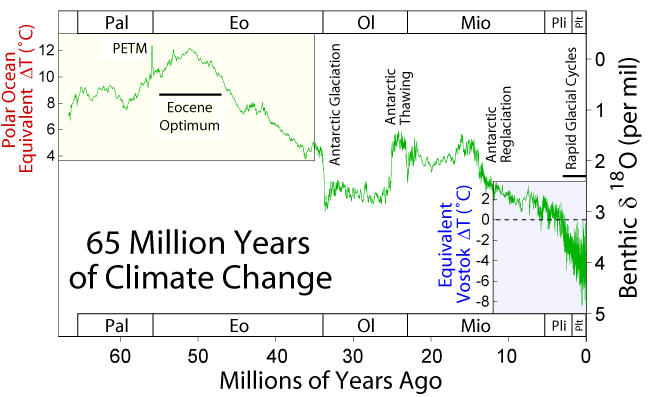
In fact, there is a time in Earth's history that more closely resembles what is happening today. 50 million years ago, India was plowing northward through the future Indian Ocean, toward the Asian landmass. The subcontinent was moving at such a fast rate that friction with the ocean floor caused CO2 that was trapped in the Earth's crust to be released in large volumes. So goes the theory. This is the closest natural approximation we have to the kind of situation we're in, where humanity has extracted carbon that was in long-term, stable storage in fossilized deposits, and converted it to CO2 in the atmosphere.

File:65 Myr Climate Change.pngSo, what happened 50 million years ago? A sophisticated proxy of the temperature at that time (an indirect index recorded in the ratio of isotopes of oxygen and carbon) reveals that there was a dramatic increase in global temperatures, as much as 12-15ยบ C. Alaska was tropical, and hosted crocodiles. At a certain point, early on in this temperature crescendo, 3000 million tons of methane hydrate, frozen on the sea floor, suddenly melted, and the global average temperature spiked for 200,000 years. There were no polar or mountain icecaps anywhere on Earth, and ocean levels were very much higher than they are now. Not only that, but ocean currents actually appear to have reversed direction for about 40,000 years. Suffice it to say, the Earth of the Eocene Optimum would seem like an alien world to today's humanity.

Our contemporary carbon pollution of the atmosphere is occurring at roughly 5 times the rate that created the Eocene Optimum. The ocean is already more acidic from industrial carbon dioxide than it ever was in the Eocene.

We begin to have some sense of the scale of the energy imbalance that we are engendering. Strangely enough, somewhere between 1/3 and 2/3 of that 3 W/m2 imbalance that we are forcing with greenhouse gas emissions is masked by reflective aerosols that we are simultaneously emitting as industrial pollution – aerosols that block sunlight, and therefore artificially cool the planet. As we tighten regulations on other pollutants, like sulfur-oxides, without regulating carbon dioxide sufficiently, we stand the risk of revealing the true impact of our contribution to global warming. Because these aerosols are only suspended in the atmosphere for a short time, if we were to stop emitting aerosols completely today, within a few weeks or months, we could see the net energy imbalance of the planet double – and that would be catastrophic.

There is one thing worth mentioning, as well. In the time it takes to equilibrate an energy imbalance, other reinforcing feedback loops can be triggered which cause the balance point to shift, and the new forcing factor may not be something we can control. For instance, we certainly don't have any way currently to keep 5,000 million tons of methane hydrates from melting on the sea floor, if they start to do so en masse. There are indications that we have so far overlooked certain potential feedback loops that could have very significant impact on the scale of global warming. So far, for example, the Earth's landmasses have continued to absorb CO2 at the same proportion, year after year, even though the total load of CO2 output into the environment from human industry has been increasing. No one thinks that this surprising pattern can persist indefinitely. In fact, an ongoing study conducted in Colorado, comparing plots of Earth subject to natural conditions with plots of Earth which have electric heaters placed over them, reveals that, as temperatures rise, the soil itself can suddenly switch to become a source of CO2, rather than a carbon sink. When it does, we can expect that the release from the soil will yield a doubling of CO2 in the atmosphere.

This, then is the emergency. We are forcing the planet warmer at a speed and intensity unmatched by natural mechanisms of climate change. We're not even in the same ballpark of effect. Though our actions may seem routine to us, they are actually unprecedented in their impact, and will assault the stability upon which civilization has depended with unbelievable force. Every once in a while, there is an event on Earth that takes only a few hours, or days, or even a handful of years to happen, but whose consequences play out for millions of years thereafter, and fundamentally shape the history of the Earth. The comet impact that extinguished the dinosaurs and transformed the planet's climate was such an event. We are now well within the theatre of yet another one, though most people don't realize it, let alone accept that they are the principal actors on the stage. In a unique moment that challenges the human mind like nothing else in our species' collective experience, we are asked to accept that the choice among alternate histories, which will unfold for millions of years to come, will be decided in the next five years.

(Written by Gavain U'Prichard)