We're preparing to travel to LA, California to join up with the start of the Great March for Climate Action, which intends to march for eight months, across the country (3000 miles), ending in Washington DC.
It starts March 1st. Who else is in?
http://climatemarch.org/


Walking Into the Storm
On a cold, leaden day this week, I am walking with my two-year-old daughter down the sidewalk in Kirksville, Missouri, having returned recently from walking with her to northern Minnesota. She is dressed in Superman pajamas, and sometimes she is hopping beside me, her little shell of a hand inside mine as I stride along, and sometimes I am swinging her up into my arms, wrapping my long wool coat around her, holding her close. In one such moment, she leans out from her woolen cocoon at my suggestion that we do the thing she learned from her six-year-old friend: she reaches out into space, grasps the tip of a leaf in her small fingers, and gently shakes the long branch the leaf adorns. "Nice to meet you, tree," she intones, sing-song.
She started doing this just a couple weeks ago, when we camping in the forests between Minneapolis and Duluth, and there were thousands of trees available to her. Now, she wants to greet every tree she can see, as we walk the business strip, but the trees are few, and mostly on the other side of the highway, busy at rush hour. The day is failing, drivers are turning on their headlights, the temperature is falling, and my daughter's "Man of Steel" outfit is the thinnest fabric you can buy. Undeterred, she waves to the trees, almost silhouettes now, standing on the far side, in the yards of apartment complexes and houses. "Nice to meet you, tree. Nice to meet you, tree."
I realize that these trees are, like so much of nature, an ignored chorus in the forgotten and waste spaces of our lives. My daughter's hello may be the first they have heard in a long time, maybe ever. But they are not a mute chorus. With bizarre insistence, they cling to their greenery, despite the change in season, the shortened sunlight, the year's declining temperatures. Hung now in useless and dangerous green leaves, vulnerable to frost, the trees are like gate-crashers from another world, a summer that doesn't end, but blazes in the grip of a too-hot planet. They are the early arrivals, and they stand there, looking confused.
I am regretting my daughter's wide eyes and open heart. She is learning to love trees just when her people are twisting the knife into nature's gaping wound. But then, that is her nature: unjaded delight and wonder. Before I had a child of my own, I wrote this verse in a song:
Remember when I left open the door?
The child, she thought the whole Earth was her floor:
she crawled on her knees, in her dress,
through the weeds and the clay --
she cried that day.
Now our home is almost gone,
she comes to ask: "Does Love still live on?"
I point to those strong trees, and my eyes, they cry --
I can't tell her why
It is so easy, it is so easy
to see us now in the beginning...
beginning to end.
In the end -- during these final three years when humanity could, with supreme effort (mostly moral and political effort) hold global warming to +2º C -- in the end, it comes down to this. If you are wondering why the weather outside your door is changing for the worse, step outside your door. If we want to really understand what is driving the insane continuation of our suicidal behavior in the face of the very public take-down Mother Nature is revving up to deliver, we must step outside the door of familiar experience.
My family has begun that journey. This summer, we walked out our front door with our children, camping supplies, and two hand-drawn carts, and headed north on the small highways of northeast Missouri, Iowa, and Minnesota. Our goal has been to walk 1,000 miles -- the distance temperate zones will be displaced poleward by 2047, at the current rate -- in the role of citizen-journalists. We have been sharing word of the massive climate destabilization unfolding in our time, and listening to the experiences and viewpoints of people along the way. This year, we walked 500 miles north, which took us to the city of Duluth, MN, on the shore of Lake Superior (the largest body of fresh water in the world, and directly under threat from climate change).
She started doing this just a couple weeks ago, when we camping in the forests between Minneapolis and Duluth, and there were thousands of trees available to her. Now, she wants to greet every tree she can see, as we walk the business strip, but the trees are few, and mostly on the other side of the highway, busy at rush hour. The day is failing, drivers are turning on their headlights, the temperature is falling, and my daughter's "Man of Steel" outfit is the thinnest fabric you can buy. Undeterred, she waves to the trees, almost silhouettes now, standing on the far side, in the yards of apartment complexes and houses. "Nice to meet you, tree. Nice to meet you, tree."
I realize that these trees are, like so much of nature, an ignored chorus in the forgotten and waste spaces of our lives. My daughter's hello may be the first they have heard in a long time, maybe ever. But they are not a mute chorus. With bizarre insistence, they cling to their greenery, despite the change in season, the shortened sunlight, the year's declining temperatures. Hung now in useless and dangerous green leaves, vulnerable to frost, the trees are like gate-crashers from another world, a summer that doesn't end, but blazes in the grip of a too-hot planet. They are the early arrivals, and they stand there, looking confused.
I am regretting my daughter's wide eyes and open heart. She is learning to love trees just when her people are twisting the knife into nature's gaping wound. But then, that is her nature: unjaded delight and wonder. Before I had a child of my own, I wrote this verse in a song:
Remember when I left open the door?
The child, she thought the whole Earth was her floor:
she crawled on her knees, in her dress,
through the weeds and the clay --
she cried that day.
Now our home is almost gone,
she comes to ask: "Does Love still live on?"
I point to those strong trees, and my eyes, they cry --
I can't tell her why
It is so easy, it is so easy
to see us now in the beginning...
beginning to end.
In the end -- during these final three years when humanity could, with supreme effort (mostly moral and political effort) hold global warming to +2º C -- in the end, it comes down to this. If you are wondering why the weather outside your door is changing for the worse, step outside your door. If we want to really understand what is driving the insane continuation of our suicidal behavior in the face of the very public take-down Mother Nature is revving up to deliver, we must step outside the door of familiar experience.
 |
| Dana "Skating the Planet" in Minneapolis |
My family has begun that journey. This summer, we walked out our front door with our children, camping supplies, and two hand-drawn carts, and headed north on the small highways of northeast Missouri, Iowa, and Minnesota. Our goal has been to walk 1,000 miles -- the distance temperate zones will be displaced poleward by 2047, at the current rate -- in the role of citizen-journalists. We have been sharing word of the massive climate destabilization unfolding in our time, and listening to the experiences and viewpoints of people along the way. This year, we walked 500 miles north, which took us to the city of Duluth, MN, on the shore of Lake Superior (the largest body of fresh water in the world, and directly under threat from climate change).
In order to understand how
this climate situation can be happening, and how people can be allowing it
to happen, we have to understand how completely – utterly, totally
– we have been dealt out of the game of wealth and financial power.
Every one of us. Every person reading this article has been handed
their hat and kicked to the curb. Driven by the ceaseless engine of
consumption, the volume of money, the profit, that comes from being
“in energy” is, in particular, unfathomable.
Money
is currency, a liquid flowing through our transactions. So, imagine a
table of water, with various drain holes in the bottom of it, forming
whirlpools. The water represents money in circulation. At one end of
the table is your hole, the size of a bathtub drain: this is your
income, your ability to draw in money, your power to pull from the
ocean of wealth. If the median household yearly income in the U.S. is
represented by a small drain, there would have to be a waterfall the
size of Niagara plunging off the other end of the table to
accurately represent the yearly net income of just one company in the
energy sector: Exxon Mobil. (The math on this analogy is shockingly accurate. The comparison of Niagara's flow rate and Exxon's profit is a 98% match, mathematically speaking.)
You can imagine the minuscule degree of power that one family unit would have to pull in water from the water table, against the yawning cataract at the other end. Even the average small business could only bring 94 bathtub drains to bear. By contrast, Exxon Mobil alone would account for nearly 850,000 bathtub drains.
You can imagine the minuscule degree of power that one family unit would have to pull in water from the water table, against the yawning cataract at the other end. Even the average small business could only bring 94 bathtub drains to bear. By contrast, Exxon Mobil alone would account for nearly 850,000 bathtub drains.
The
point is this: We all know there is great (and widening) wealth
disparity in the U.S. and in the world. Most people don't really know
how to imagine the degree to which income distribution is skewed. A
recent study demonstrated asked individuals to apportion U.S. revenue
amongst a hypothetical 100 people in two ways. A) They were asked to
divvy the money amongst the 100 people in what they thought was a
realistic representation of today's income disparity. B) They were
asked to distribute the money according to what would seem a fairer
income spread across society, the kind of society these individuals
would like to live in. The researchers found that the test subjects
were off the mark in trying to represent the current wealth disparity
by as wide a margin as existed between the subject's “reality”
distribution and ideal distribution. In other words, income
imbalance, as it stands, is twice as large as people think it has
strayed from a fair distribution.
More
to the point, when we talk about the one-percenters, or the
one-percent-of-the-one-percenters, we are homing in on the domain of
the energy industry. Exxon Mobil is the world's most lucrative
company. Its buying power is a Niagara Falls among household
plumbing. There are few social, political, economic, regulatory, and
judicial doors that kind of force can't open (or close off, as need
presents itself). Remember, Exxon Mobil is just one company. Taken as
a whole, the fossil fuel giants have the power to change Earth's
history.
Such
power breeds cutthroat opportunism. The lasting coup of this set is to have normalized their
business, without a sense of shame, without a public outcry, without
a halt in the day-and-night increase of their revenue. There is
momentum on such a huge scale for this industrial, commercial way of
doing things, and the fossil fuel
businesses profit so handsomely by it, that the industry will persist
beyond the last outpost of sanity, forging ahead even as the world
which it powers crumbles into ruin. How do you turn Niagara Falls
off?
Most
of us are living as if we're still somehow dealt into the game of
prosperity. Education, a few good connections here, some effort and
self-promotion and cleverness there, and we manage to muddle through, and even enjoy ourselves. It is hard to remember that for most of the 30,000 years that modern humans have walked the Earth like my family did this summer, we were not trapped by a process of diminishing returns to the people, and the Earth was more fascinating to us than profit. We have taken an abundant planet and made it a demented casino where we're all losing.
As a practical, effective step against the climate folly, Pacing the Planet has been almost completely ineffective. We knew it would be like that, going in. Holding up our flimsy, almost-anonymous action against the daily assault on the planet, it is easy to see that our effort is futile. But maybe it presses the question.
How do we, as the people alive on Earth at this moment of crisis, deal with our immersion in the root cause of this crisis? That question is morally imperative for those living in this current civilization to answer personally. When you do, refer to all 30,000 years of our "modern" history, not just the few hundred years during which the economy we're all too familiar with has shackled us to its version of "the way things must be."
When Niagara (and more) is pouring, minute by minute, hour by hour, into the obliteration of the planet we know, the verdict is clear: if we want something different, we must fight for our world. Really fight. Part of this "fight" is abstract combat, confronting the fantasy that our planet is immune to our abuse of it. We need widespread conversation and education about the rapidly advancing state of deterioration to the basic forces of abundance and stability that have provided us life since before machines and religion and money and private property were a dim thought in the minds of our ancestors.
Part of this fight rests on the dignity of humankind, standing in non-violent but strong resistance, immovable in our numbers and our physical commitment to put our bodies in the way of destruction. Hundreds are already doing this for the climate.
Yet, the clock marking the end of a forgiving climate is running, and the invisible point-of-no-return may even now be under our feet, beyond which the natural world enters a new age of crazy. Recent history shows that, when oppression needs to be broken within a decade, the tool to accomplish that outcome is guerrilla insurrection. Now comes the time to fight illegally, fight aggressively, fight with powerful tactics, fight like an animal cornered, with the terrible wrath of the will to live.
The means to carry on such a campaign of delay and attrition is within reach of an organized opposition. It requires a willingness to go down the black roads that the CIA and other government agencies have traveled, in collusion with industry and corporate support, to put us in bed with the ruin of the world in the first place. Will we be unwilling to use "dirty tricks," against the fossil fuel industries run by "our own people," even if they are taking the climate beyond the point of no return? There are current examples of the few employing sabotage and obstruction to interfere with immoral industry: The Sea Shepherd Conservation Society crosses the line of nonviolence, aggressively confronting whalers with water cannon and the hulls of their own ships. Yet, they are frequently hauled into court, for their ships are registered and recognizable. Whether Sea Shepherd is having a significant impact limiting the scope of the illicit whaling industry remains to be seen. By contrast, guerrillas confronting the most well-funded and embedded industry in the world will need to strike and disappear, over and over, and operate on a large scale, creating a basic social instability that we have never experienced in the United States. Will we take that medicine to save the Earth?
Most of the passionate advocates for action are steeped in the philosophy of nonviolence, and they oppose violently resisting the onslaught of the fossil fuel industry, even at this advanced stage. Their opposition rests on ethical grounds, in the conviction that violence begets violence, and that we must create the world we want to see, not a world of war with ourselves. Yet, we are being attacked violently right now, and the consequences of not defending ourselves is a lot of death and ruin. We might be brave enough to walk individually into the line of fire undefended, get ourselves arrested or killed under a bulldozer (like Rachel Corrie), but do we have the right, having understood what is at stake, to take millions (or billions) of lives with us?
The denouement of the 1980s film "The Mission" features protagonists Jeremy Irons and Robert De Niro unresolved in their difference of opinion about how to defend a group of Amazon Indians who are, once again, slated to either be rounded up as slaves or exterminated in the forest. Irons plays a Jesuit priest who has led the Indians to Christ, and he prepares his congregation to walk unarmed out to the advancing Portuguese soldiers, bearing a cross. Meanwhile, De Niro's character, a former slave hunter himself, knows firsthand the depravity of the human spirit and the unlikelihood of receiving mercy or reconsideration from the approaching army. He arms the Indians as best as he is able, and teaches them how to ambush the military.
In the end, the De Niro's character is felled by the Portuguese soldiers, and, as the thatched huts of the natives are set on fire, the priest and his contingent process slowly from the burning church. They, too, are cut down by gunfire. Everything is lost, and only some children escape alone into the jungle.
Warning: This video portrays violence.
In a terrible conjunction with real life, the same people portrayed in the film, the Guarani, are once again engaged in struggle on multiple fronts with companies logging endangered Amazonian trees, oil companies wanting to drill in the forest (building roads for heavy machinery into the jungle) and ranchers who are clearing forest in huge swathes for cattle raising and soy-bean plantations. The acres of soy beans, by the way, are an effort by farmers to capitalize on the boom of interest in biofuels. The Amazon is under such stress that it is considered to be a certain casualty of climate change, if we allow average global temperature to rise 3° C. That is, the entire forest will disappear. As for the Guarani, a tribe of 150 shocked the world last year when they pledged to commit suicide rather than be forced from a location in Brazil that has served as their burial ground for centuries. Are we really going to tell people like the Guarani, who have been subjected to centuries ongoing of ruination of everything sacred to them that the only confrontation on their behalf that their comrades in the west will offer up is nonviolent protest? What about the native people of the Athabascan wilderness, who are watching this transformation of their home:
There are other reasons to augment the approach to fighting climate disaster. Nonviolence doesn't just land you in the Birmingham Jail, anymore. If you are a reasonably polite and ineffective protester, the police may practice "catch and release" with you, booking you with a misdemeanor charge, and letting you go. Or, as the National Park Service did with protesting luminaries such as Bill McKibben and James Hansen, the authorities may agree beforehand to a "catch and release" plan, only to change it up and hold you for several days. If you are taking action that actually causes shareholders to lose some profit (like obstructing the building of a pipeline), you will be sued for a greater amount of money than you or your collective could ever hope to pay: sometimes, millions of dollars for a single day of civil disobedience. And if your collective is skillful at organizing and executing direct action, your group will almost certainly be the target of surveillance by the Homeland Security Agency, and charges against you may be augmented by "terrorism enhancements," which enable the government to detain you in isolation, perhaps without the protection of habeas corpus.
All right, enough review. Here's the most important argument for embracing the violence involved in destroying fossil fuel infrastructure: if violence is defined as harm to life, then there is a whole domain for action against the machinery of carbon pollution, where the loss of life can be prevented, and the hardship imposed by the action (for instance, the loss of jobs) can be addressed administratively. If violence is defined as any abrupt physical change or destruction, then... the whole Universe is filled with violence. It seems to me that the distinction people with a working moral compass want to make is between action that is benevolent and action that is malicious. This distinction is key, because it is entirely possible to dismantle the engine of our carbon climate doom without malice, but it will almost certainly require acts of violence. It is possible to forcefully defend the vulnerable without malice toward the aggressors, and to direct force so that the well-being of the aggressors is held as a matter of equal concern. The martial art of aikido is based on this philosophy, for example.
There is, of course, another way to do violence, and that is violence to ourselves. We can shut down carbon pollution in a minute, if we truncate the lifestyle that demands it. Imagine 314 million people renouncing the life of excessive convenience and disposable permanence which has wrecked our world. Imagine 314 million people refusing to consume massive amounts of factory-farmed meat, agreeing to use their private property cooperatively for the purpose of living within our planetary means (not to mention, the hidden spiritual joy of complete generosity -- but that is for a different essay).
This is way beyond the avenues for disavowal of the gluttony of the West offered by green consumerism. Because of the huge drag of Niagara and a few others on the pool of our economy, we cannot count on a practical solution to the climate crisis that works within the same pool, the same economy. Simply by participating in any way in the economy as it is, we each are compounding and magnifying the crisis beyond our individual means to offset the damage. We are talking about a few years (maybe ten or fifteen years) of refusing to meet our needs in the routine ways, refusing to do jobs that don't matter, facing the uncertainty of our survival now, voluntarily, rather than putting it off for a couple decades (of increasing hardship)... until the circumstances of death and tragedy make our lives as we've known them impossible anyway. In these immediate years, when the great profiteers of global capitalism are brought low by the evaporation of demand for our unsustainable current reality -- in these years, we will be hard at work rolling out renewable energy sources, efficient power delivery systems, and smart, cooperative ways of using that power. We will create a huge global financial and resource surplus that will take the world's economies out of debt, elevate everyone out of a desperate struggle for survival, and establish the kind of equity that could set us up for the future of peaceful prosperity envisioned by sci-fi author Gene Roddenberry.
Arguably, it would be more noble to commit this abrupt, violent cessation of our demand than wage a guerrilla war of sabotage upon the fossil fuel supply lines. However, without massive social reorganization by force, of the type carried out in the USSR in the 1920s, we just haven't moved fast enough as a collective flock to curtail ourselves.
So, we are left with civil disobedience and forcible resistance against the machinery of disaster. I look at my daughter, and I wonder if she would object to these thoughts, if she would mind very much my trying to save her life with force. Maybe, it is more a matter of defending her life with my passionate vitality, now, rather than her father existing as a ghost in the twilight of a failed age. I don't want her unjaded heart to have been in vain.
Yet, there is the danger now that our entire human participation in the planet will have been in vain, or worse: a detriment, a great fuck-up upon the Earth that will last longer than humanity itself was here. Carl Sagan, looking at a photograph of Earth taken from 6 billion miles out in space, had this to say about the "pale blue dot" barely visible in the dark night of the Universe:

The sad truth is that the current masters of this dot will rape our heavenly body because they have forgotten how to have the shiver of joy and wonder when they say, "Nice to meet you." They are asking for forgiveness rather than permission, and, if we're not careful, no one will be able to answer. Oh yes, and here's the other truth: we are still the masters of this dot at this moment. So, with all respect and love possible, we must fight.
As a practical, effective step against the climate folly, Pacing the Planet has been almost completely ineffective. We knew it would be like that, going in. Holding up our flimsy, almost-anonymous action against the daily assault on the planet, it is easy to see that our effort is futile. But maybe it presses the question.
When Niagara (and more) is pouring, minute by minute, hour by hour, into the obliteration of the planet we know, the verdict is clear: if we want something different, we must fight for our world. Really fight. Part of this "fight" is abstract combat, confronting the fantasy that our planet is immune to our abuse of it. We need widespread conversation and education about the rapidly advancing state of deterioration to the basic forces of abundance and stability that have provided us life since before machines and religion and money and private property were a dim thought in the minds of our ancestors.
Part of this fight rests on the dignity of humankind, standing in non-violent but strong resistance, immovable in our numbers and our physical commitment to put our bodies in the way of destruction. Hundreds are already doing this for the climate.
Yet, the clock marking the end of a forgiving climate is running, and the invisible point-of-no-return may even now be under our feet, beyond which the natural world enters a new age of crazy. Recent history shows that, when oppression needs to be broken within a decade, the tool to accomplish that outcome is guerrilla insurrection. Now comes the time to fight illegally, fight aggressively, fight with powerful tactics, fight like an animal cornered, with the terrible wrath of the will to live.
The means to carry on such a campaign of delay and attrition is within reach of an organized opposition. It requires a willingness to go down the black roads that the CIA and other government agencies have traveled, in collusion with industry and corporate support, to put us in bed with the ruin of the world in the first place. Will we be unwilling to use "dirty tricks," against the fossil fuel industries run by "our own people," even if they are taking the climate beyond the point of no return? There are current examples of the few employing sabotage and obstruction to interfere with immoral industry: The Sea Shepherd Conservation Society crosses the line of nonviolence, aggressively confronting whalers with water cannon and the hulls of their own ships. Yet, they are frequently hauled into court, for their ships are registered and recognizable. Whether Sea Shepherd is having a significant impact limiting the scope of the illicit whaling industry remains to be seen. By contrast, guerrillas confronting the most well-funded and embedded industry in the world will need to strike and disappear, over and over, and operate on a large scale, creating a basic social instability that we have never experienced in the United States. Will we take that medicine to save the Earth?
Most of the passionate advocates for action are steeped in the philosophy of nonviolence, and they oppose violently resisting the onslaught of the fossil fuel industry, even at this advanced stage. Their opposition rests on ethical grounds, in the conviction that violence begets violence, and that we must create the world we want to see, not a world of war with ourselves. Yet, we are being attacked violently right now, and the consequences of not defending ourselves is a lot of death and ruin. We might be brave enough to walk individually into the line of fire undefended, get ourselves arrested or killed under a bulldozer (like Rachel Corrie), but do we have the right, having understood what is at stake, to take millions (or billions) of lives with us?
The denouement of the 1980s film "The Mission" features protagonists Jeremy Irons and Robert De Niro unresolved in their difference of opinion about how to defend a group of Amazon Indians who are, once again, slated to either be rounded up as slaves or exterminated in the forest. Irons plays a Jesuit priest who has led the Indians to Christ, and he prepares his congregation to walk unarmed out to the advancing Portuguese soldiers, bearing a cross. Meanwhile, De Niro's character, a former slave hunter himself, knows firsthand the depravity of the human spirit and the unlikelihood of receiving mercy or reconsideration from the approaching army. He arms the Indians as best as he is able, and teaches them how to ambush the military.
In the end, the De Niro's character is felled by the Portuguese soldiers, and, as the thatched huts of the natives are set on fire, the priest and his contingent process slowly from the burning church. They, too, are cut down by gunfire. Everything is lost, and only some children escape alone into the jungle.
Warning: This video portrays violence.
In a terrible conjunction with real life, the same people portrayed in the film, the Guarani, are once again engaged in struggle on multiple fronts with companies logging endangered Amazonian trees, oil companies wanting to drill in the forest (building roads for heavy machinery into the jungle) and ranchers who are clearing forest in huge swathes for cattle raising and soy-bean plantations. The acres of soy beans, by the way, are an effort by farmers to capitalize on the boom of interest in biofuels. The Amazon is under such stress that it is considered to be a certain casualty of climate change, if we allow average global temperature to rise 3° C. That is, the entire forest will disappear. As for the Guarani, a tribe of 150 shocked the world last year when they pledged to commit suicide rather than be forced from a location in Brazil that has served as their burial ground for centuries. Are we really going to tell people like the Guarani, who have been subjected to centuries ongoing of ruination of everything sacred to them that the only confrontation on their behalf that their comrades in the west will offer up is nonviolent protest? What about the native people of the Athabascan wilderness, who are watching this transformation of their home:
 |
| Tar Sands mining is doing this to the Albertan wilderness. |
There are other reasons to augment the approach to fighting climate disaster. Nonviolence doesn't just land you in the Birmingham Jail, anymore. If you are a reasonably polite and ineffective protester, the police may practice "catch and release" with you, booking you with a misdemeanor charge, and letting you go. Or, as the National Park Service did with protesting luminaries such as Bill McKibben and James Hansen, the authorities may agree beforehand to a "catch and release" plan, only to change it up and hold you for several days. If you are taking action that actually causes shareholders to lose some profit (like obstructing the building of a pipeline), you will be sued for a greater amount of money than you or your collective could ever hope to pay: sometimes, millions of dollars for a single day of civil disobedience. And if your collective is skillful at organizing and executing direct action, your group will almost certainly be the target of surveillance by the Homeland Security Agency, and charges against you may be augmented by "terrorism enhancements," which enable the government to detain you in isolation, perhaps without the protection of habeas corpus.
All right, enough review. Here's the most important argument for embracing the violence involved in destroying fossil fuel infrastructure: if violence is defined as harm to life, then there is a whole domain for action against the machinery of carbon pollution, where the loss of life can be prevented, and the hardship imposed by the action (for instance, the loss of jobs) can be addressed administratively. If violence is defined as any abrupt physical change or destruction, then... the whole Universe is filled with violence. It seems to me that the distinction people with a working moral compass want to make is between action that is benevolent and action that is malicious. This distinction is key, because it is entirely possible to dismantle the engine of our carbon climate doom without malice, but it will almost certainly require acts of violence. It is possible to forcefully defend the vulnerable without malice toward the aggressors, and to direct force so that the well-being of the aggressors is held as a matter of equal concern. The martial art of aikido is based on this philosophy, for example.
There is, of course, another way to do violence, and that is violence to ourselves. We can shut down carbon pollution in a minute, if we truncate the lifestyle that demands it. Imagine 314 million people renouncing the life of excessive convenience and disposable permanence which has wrecked our world. Imagine 314 million people refusing to consume massive amounts of factory-farmed meat, agreeing to use their private property cooperatively for the purpose of living within our planetary means (not to mention, the hidden spiritual joy of complete generosity -- but that is for a different essay).
This is way beyond the avenues for disavowal of the gluttony of the West offered by green consumerism. Because of the huge drag of Niagara and a few others on the pool of our economy, we cannot count on a practical solution to the climate crisis that works within the same pool, the same economy. Simply by participating in any way in the economy as it is, we each are compounding and magnifying the crisis beyond our individual means to offset the damage. We are talking about a few years (maybe ten or fifteen years) of refusing to meet our needs in the routine ways, refusing to do jobs that don't matter, facing the uncertainty of our survival now, voluntarily, rather than putting it off for a couple decades (of increasing hardship)... until the circumstances of death and tragedy make our lives as we've known them impossible anyway. In these immediate years, when the great profiteers of global capitalism are brought low by the evaporation of demand for our unsustainable current reality -- in these years, we will be hard at work rolling out renewable energy sources, efficient power delivery systems, and smart, cooperative ways of using that power. We will create a huge global financial and resource surplus that will take the world's economies out of debt, elevate everyone out of a desperate struggle for survival, and establish the kind of equity that could set us up for the future of peaceful prosperity envisioned by sci-fi author Gene Roddenberry.
Arguably, it would be more noble to commit this abrupt, violent cessation of our demand than wage a guerrilla war of sabotage upon the fossil fuel supply lines. However, without massive social reorganization by force, of the type carried out in the USSR in the 1920s, we just haven't moved fast enough as a collective flock to curtail ourselves.
So, we are left with civil disobedience and forcible resistance against the machinery of disaster. I look at my daughter, and I wonder if she would object to these thoughts, if she would mind very much my trying to save her life with force. Maybe, it is more a matter of defending her life with my passionate vitality, now, rather than her father existing as a ghost in the twilight of a failed age. I don't want her unjaded heart to have been in vain.
Yet, there is the danger now that our entire human participation in the planet will have been in vain, or worse: a detriment, a great fuck-up upon the Earth that will last longer than humanity itself was here. Carl Sagan, looking at a photograph of Earth taken from 6 billion miles out in space, had this to say about the "pale blue dot" barely visible in the dark night of the Universe:

"The Earth is a very small stage in a vast cosmic arena. Think of the endless cruelties visited by the inhabitants of one corner of this pixel on the scarcely distinguishable inhabitants of some other corner, how frequent their misunderstandings, how eager they are to kill one another, how fervent their hatreds. Think of the rivers of blood spilled by all those generals and emperors so that, in glory and triumph, they could become the momentary masters of a fraction of a dot.
Our posturings, our imagined self-importance, the delusion that we have some privileged position in the Universe, are challenged by this point of pale light. Our planet is a lonely speck in the great enveloping cosmic dark. In our obscurity, in all this vastness, there is no hint that help will come from elsewhere to save us from ourselves."
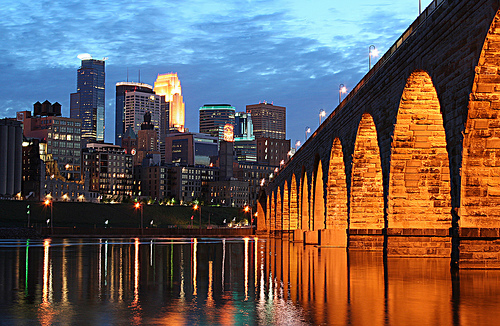
Pacing the Planet -- Week 12: Metropolis
 |
| City of Lakes |
We arrived in St. Paul, by coincidence, in time for the season-opener of the Minnesota Public Radio program, "Prairie Home Companion," and the traditional meatloaf dinner and street dance. Our cart, with its various insignia, stood on a knoll overlooking the stage erected on Exchange Street downtown, where the host, Garrison Keillor, musicians and performers continued the show on into the dark and rain.
Skating and pulling a cart in town, sometimes downtown at rush hour, has been thrilling. Dana's skates had been wearing a painful hole in her ankle, but she got a new pair of skates this week (with perfectly geeky yellow toe-covers). She can do anything now! (Dana can hardly wait to return home so that she can start skating as "Greenhouse Gashes" with Kirksville's new roller derby team, the NEMO Viqueens!) Also, Gavain installed a bicycle brake system on the cart...an appreciated safety feature.
It should be noted, however, that we never skate the cart with our todder in tow. Only ever, when she is safe at camp with her other parent, do we get to fly along in this many-wheeled manner.
On another day this week, we walked through the sprawling campus of the University of Minnesota, drawing the attention of students to the emergency unfolding in their midst. When we attended the monthly meeting of the Minnesota chapter of the "350.org," we learned how immediate that threat is for the people of the North Star State.
 |
| Enbridge Inc.'s master plan |
Enbridge's plans have largely flown under the radar of scrutiny, but the facts are stark. If completed, the Enbridge pipeline will carry a greater volume of Tar Sands oil than its far more infamous competitor, the Keystone XL. Tar Sands oil excavation has been called the most devastating project on Earth, both for ruining the Athabasca Wilderness, the spilling of thousands or millions of gallons of oil along the pipeline route, and the overwhelming effect that extracting and burning that oil will have on global warming. Top climatologist, James Hansen, has called burning the Tar Sands "game over" for the climate.
Readers of this article join a very small percentage of the public who have even heard of this project. Minnesota 350 organizers are fighting Enbridge at the border, where the proposed pipeline is subject to federal review and regulation.
What a powerful change of experience, to be with people who admit that the climate crisis is the defining issue of our time! The people of MN350 are of many ages, full of heart, kind yet fierce, passionate volunteers, empowering others and taking direct action to challenge the wrongful exploitation of resources which fuels the corporate takeover of the climate. The attendees of the meeting gave a standing ovation for Pacing the Planet, and expressed how deeply moved they are by our will to go beyond the shelter of our home to report the climate crisis.
Pacing the Planet -- Week 11: Race for the Twin Cities
 Pacing the Planet is back on the road
as a leaner, swifter version of itself, with an evermore urgent message to share. We resumed from where we left off in southern
Minnesota, and are racing for Duluth, hoping to beat the return of
cold weather with its predominant north wind. In the last week, we
have traveled more than 100 miles and arrived at the Twin Cities of
Minneapolis and St. Paul.
Pacing the Planet is back on the road
as a leaner, swifter version of itself, with an evermore urgent message to share. We resumed from where we left off in southern
Minnesota, and are racing for Duluth, hoping to beat the return of
cold weather with its predominant north wind. In the last week, we
have traveled more than 100 miles and arrived at the Twin Cities of
Minneapolis and St. Paul.
We will be spending the next week in
this metropolitan area, the most populated on our entire route to
northern Ontario. Minneapolis is the only locale on our route to host
a local chapter of the international organization, “350.org,”
which seeks to put pressure on government and institutions to divest
financially from fossil fuel companies. “350.org” also advocates
civil disobedience as an important tool and citizen responsibility to
confront collusion between government and fossil fuel corporations.
In local climate change news, the
Flanagan South Pipeline, under construction by Enbridge Inc., a
Canadian company, is designed to carry bitumen oil from the Tar Sands
of Alberta through our home area. The Flanagan Pipeline would carry
Tar Sands oil from Illinois, through northeast Missouri, including
Shelby County, to Oklahoma City. From there, the oil would continue
down to Gulf Coast refineries. The project is being covertly
fast-tracked.
Before we departed for this second
phase of our walk, we attended a presentation by a collective of
people who are organizing communities to resist construction of the
Flanagan South Pipeline. These people have even blocked use of heavy
machinery at the construction sites with their own bodies. They
described how landowners along the proposed route of the Flanagan are
being bullied into accepting fire sales of their properties, under
threat of having their land seized through eminent domain action.
Owners have been later surprised to learn that eminent domain claims
can be contested. Furthermore, such pipelines are liable to leak
toxic fuel onto the land and in the water, as residents in Mayflower,
Arkansas found out this spring. We are available to provide
information to Missouri residents who want to join the coalition to
halt the pipeline.
As for Pacing the Planet: our
speediness, this time around, is due to our traveling with one cart
(with the all-terrain wheels), one child (our youngest daughter, aged
2), and with a new form of locomotion for our project: roller
skates. In fact, of the last 100 miles we've traveled, most of them
have been covered while skating with the cart in tow. Our presence on
the road is now more visually striking, in addition to being faster.
Our daily routine involves strapping on our knee and elbow pads,
wrist guards, helmets, and adapting ourselves to the variable
conditions of the shoulder of the road. With the hazards of pebbles,
broken bits of car, frequent dead frogs, turtles, and racoons, and in
one memorable spot, a box of nails, we find skating gives us
something to focus on mentally during the hours of travel, and
develops a different set of muscles than walking does. At its best,
coasting down the highway on skates maybe comes close to the freedom
of the personal jet pack that so many have sought.
We were interviewed by the Mankato Free
Press, a newspaper serving that city and surrounding communities that
has a circulation of somewhere near 40,000. We were featured on the
front page of the local section with a large color photo, and the
accompanying article is the best yet on Pacing the Planet.
At the same time, a lot of critically
important news about the climate situation has emerged in the last
month. The 2014 report of the Intergovernmental Panel on Climate
Change is about to be released any day, and its findings are stark.
The report is expected to declare with 95% certainty that human
activity is driving the majority of global warming, and that the
consequences within this century will be catastrophic if action is
not taken immediately.
Researchers may now have the answer to
one of this past decade's climate questions, namely, “Why has the
increase in global average surface temperature in the last ten years
not kept pace with the amount we have increased the Greenhouse
Effect?” The reason appears to be that the deep ocean is
temporarily storing most of that heat. Another study finds that an
ongoing, natural cycle in the sea surface temperature has probably
been masking most of the warming signal. Both of these studies
anticipate that the absorbed heat can and will reappear, creating a
spike in global surface temperatures in the near future. Beware of
people spouting arguments which try to discredit the scientific
consensus on global warming on the basis of temperatures this past
decade.
As it is, a group of researchers
looking at the extreme weather events of 2012 across the planet,
through computer modeling, were able to conclusively tie half of the
events to climate change from global warming, either in the causes of
the event, or in the severity and reach of the consequences. The
researchers note that the remaining events may well be influenced by
global warming, but they were not able to draw that conclusion from
the computer modeling used.
(You know, scientists are strictly precise with their wording. They say “maybe” when a bias-funded news caster would say “absolutely.” Scientists say “seems to indicate” when a commercial radio personality would say “clearly shows.” As we each do our best to discern fact from fiction in the world of abundant information, we must recognize this linguistic distinction, and resist the temptation to believe the argument which is most-vehemently expressed. The ones who are standing in the spotlight, gesticulating, calling their opponents names like idiot and moron, tend to be the ones who have the weakest argument on paper.)
Once we have a broad social
understanding that extreme weather is being triggered and made worse
by global warming, then there will also be a clear recognition of the
necessity of moving quickly to limit the forcing of the climate
through carbon emissions. We all have people and causes which we care
about, above all else. It is time to stand up in defense of
everything that we love.
This is the conversation we will be
having with people in the Twin Cities, as we meet our largest
audience yet.
Week 10 - Fear Not, Fail Not
 |
| The walk so far |
walking to the tiny hamlet of Amboy, MN, where we have left our carts in storage. We are announcing that Pacing the Planet is officially on hold, and we have returned to our home in Missouri, to tend to our house, and to raise funding for the next part of our walk. We plan to recruit more people for our walk before we continue. So far, our company has traveled more than 300 miles on foot.
We wish to thank those who have helped us get this far: in particular, to our families, who have made ongoing financial contributions to make this walk possible; to Gavain's sister, Zoe, for providing our rolling headquarters; to Jason and Laura, for assisting us generously, serving as mail depot, and providing us with a staging ground for the northern half of our journey; to Stan and Echo, who have helped mind our house while we have been gone, and coordinated the publishing of these articles. Without the help of a few generous individuals, need would have sooner turned us from the path of walking.
Therein lies the problem. A movement of only individuals to address the rapid destabilization of the climate is almost certain to fail. Have we forgotten how to mobilize an entire society? By far, the most common response that we have received when we explain the purpose of our walk is indifference -- and the second-place holder is a good-natured, but empty, "Good luck," or "Have fun." The third-most frequent reply is some words about the changing weather, and idle curiosity about how we are funding this adventure of ours.
All three of those outcomes are failure: communication missed, passion drowned, climate changed. Few and far between are the people who really get the context for this moment of Earth's history, and understand that this is a "drop everything" crossroads for humanity. Unfortunately, because failing so often is an embarrassing drag, many people don't want to be associated with this work. So, from the beginning, Pacing the Planet has found a gallery of onlookers just waiting for us to fail. They tell us that the effort is too hard, or that the idea of walking was flawed in the first place, that we won't and can't make a meaningful difference this way. Others in the gallery are silent, waiting for us to come to our senses, come home and be normal, before they'll be friends or family with us again.
Not one of these people is doing anything remotely as effective as Pacing the Planet to tackle the runaway climate, and most of them know that. There is such a strong cultural taboo against seeming like an idealist and renouncing the status quo, that these people would rather do nothing than mortify themselves on the cross of public perception.
Yet, climate change is a cross we are already bearing, whether we realize it or not. And, cynicism is going to look pretty stupid when the innocents you know are suffering for it. That the climate is destabilizing is no longer in question. The big news this week is that researchers have found evidence that the enormous East Antarctic Ice Sheet -- which holds more water than Greenland or West Antarctica -- has melted rapidly in the past, in response to atmospheric carbon dioxide levels that we have already reached this year, and a global temperature that we will reach in the first half of this century. Scientists had thought the East Antarctic Ice Sheet was so stable, they had hardly bothered to study it. Now, they will be scrambling to give us a better forecast of what it is really going to do.
We will continue our walk in the coming weeks and months. Now is not the time to retreat into embarrassed anonymity. We will not be casualties of cowardice, nor of our own convenient rationalizations. The world is changing, the difference is meaningful, and we will meet you on the road.
Week 9 -- Delay and Dilly Dally

Being
stuck in one place has allowed us some unusual opportunities. Blue
Earth is home of the Green Giant frozen vegetable company, and every
year at this time the town holds fireworks, a parade, and other
events in a mini-festival called "Giant Days," all under
the presumed benevolent gaze of a 53-foot-tall fiberglass statue of
the Jolly Green Man himself. We paid the entry fee and joined the
parade, sashaying our way down Main Street to the strains of "Pretty
Woman" arising from the teen marching band behind us, while
handing out copies of our newly revised Climate Crisis Information
Sheet. It was a strange event, to be sure.
Our
new information sheet is more specific in its prescription for
responding to the climate situation. So much news is coming daily
about the climate that there is a new hazard for our project: if we
introduce ourselves as simply "climate activists," or
"walking to raise awareness about the climate situation,"
many people will assume they know what our message is; and, yet, our
message is still starkly different than what the politicians and
journalists are saying, even now. In a nutshell, climate policy that
isn't based on the scientific understanding of the climate system's
limitations means nothing at all, will not save our planet for us.
As we
walk, it is obvious the planet is changing. Not only does the land we
pass through seem different, and person after person tells us that
their homeland is not what it was when they were growing up (this
from 70-year-olds and 20-year-olds alike), but the train of news
stories about extreme weather disasters continues unabated. Colossal
floods in India, 6,000 people missing, presumed dead. Nineteen
firefighters dead in Arizona, charred in a huge fire that no one
could contain. This is the crazy world we are birthing. Events that
boggle the human imagination cartwheel through the 24-hour news cycle
and disappear beneath the froth of our current distractions. This
week, an "iceberg" larger than the city of Chicago
splintered off Antarctica at a location where two large fissures
appeared suddenly last year in a great ice shelf. It now drifts in
the Southern Ocean, thousands of miles from civilization but still
telling the time of the planet.
While
we are essentially "stuck in place" for the time-being, we
read about Australia and its current struggles with climate
regulation. Australia is considering abandoning its carbon "tax,"
even though economists, scientists, and fossil fuel industry people
are all in support of the program that created it, and the tax is
having a measurable effect in reducing Australia's greenhouse gas
emissions. The coalition that put the policy in place is threatening
to fracture under the stress of the opposition declaring that the
"tax" represents a broken political promise and will
bankrupt Australian families. (The political opposition there has
been unable to find a single Australian economist to back that
opinion up.)
Australia
is an important bellwether for the U.S. for a few reasons. Although
Australia has a more-complex multi-party coalition government (or
maybe because of it), they are the only major greenhouse polluting
country to impose a carbon fee -- limited as it is. Created in 2010,
the carbon fee program has already demonstrated itself to be
effective in curtailing pollution, despite the fact that Australia is
the heaviest emitter of greenhouse gases per household in the world.
250 Miles; Week 8
 |
| Tillwyn, joyful with wind and yogurt, at a rest stop north of Algona |
We have now completed one-quarter of our northward journey, and with that comes a sobering thought: it would take most species 25 years to shift their habitat ranges by the same amount that we have walked in just 8 weeks. That is, if they can make the move at all.
One-quarter in, and we are doing well, having grown strong enough that the slight hills we are beginning to encounter again seem like no big deal. Walking on the left side of the road into oncoming traffic has started to feel normal, and accelerated our pace. Several times this week we set new records for ourselves, walking 11 miles one day and eighteen miles the next, thanks to a new option we generated for ourselves: a solo walker bearing a flag that we painted with the image of a burning planet.
After an initial mishap in Fort Dodge, IA (where our wagon was towed and impounded from a Fareway grocery store at the behest of an unsympathetic manager), we walked north along the exceedingly windy U.S. highway 169 for many miles and many towns, bringing us within a stone's throw of the Minnesota border by week's end (at least, if a very large giant were throwing it). In the town of Algona, IA, we encountered a well-attended annual motorbike rally, and spent a somewhat surreal day walking along a tiny country highway, parallel to 169, to the constant sound of motorcycle engine backfire, and pods of bikers, like schools of fish, streaking past us from behind and in front. By the end of the day the crowd had thinned so that small groups of bikes, or solitary riders, lazily droned past us like bumble bees or dragonflies.
We spend hours walking alongside fields whose soy plants are too small for the time of the year, corn that looks spring-tender while a summer sun beats down upon it now. The farmers who ride out on the gators to speak with us (and many do) worry that crops which were delayed in planting by weeks by torrential rainfall and flooding will now burn up because the shallow roots that have developed won't provide the plants enough water. We've had interesting conversations with those farmers about changing jet-stream and rainfall patterns that come with our changing climate, and we've handed out most remaining copies of the first printing of our Climate Crisis Information Sheet.
Everyone is talking about the climate crisis now. You cannot go to a news outlet without seeing a half-dozen stories about the situation, day after day. The floodgates have opened. The question, of course, is will the response be enough, be in time to make a difference? The President has declared that to doubt climate change and its imminent importance is to belong to the "Flat Earth Society." As we pace, we are now encountering very little skepticism that our world is changing. Our country's race for the planet has finally, finally begun.
Week Seven: Spinning Synchrony
Any description of Week Seven must begin with the extraordinary generosity and love of Laura and Jason, the new proprietors of the Whispering Oaks Campground in Story City, IA, with whom we immediately fell into an easy friendship. They are delighted with our children, and spent many hours during the week keeping the children company, teaching them to drive a golf cart all over the meadows of the park, planting gardens with them, and being a second set of parents to them. We were happy to confer with Laura over her plans to bring out the magic of the Whispering Oaks land, making the campground self-sustaining with electricity generation and water catchment and simple cabins. As we came to learn about each other more deeply, we discovered kindred spirituality in our new friends. They are both from Minnesota, and we look forward to meeting up again with Laura and her children on the northward path in her home state.
This week began with a boat trip in Egon's new inflatable raft, a gift from his grandparents for his eleventh birthday. We put into the Skunk River, which eased along the edge of our campground in Story City. Based on what we'd read about the river online, we thought we might be able to make it all the way down to the north end of Ames, Iowa in about 5 hours...with an hour to spare preparing for our climate change presentation which was scheduled for that evening at a cafe called "Stomping Grounds". But the river was shallow, slow and log-jammed! We had a great adventure, got just the right amount of sun and wet, pulled out again after 4 miles or so and called our back-up transportation (Thanks, Keith!). We had to leave the raft at the river access point.
The presentation was well attended, especially considering the last-minute nature of its organization (Thanks, Angela!). Fortunately, some of the attendees brought their children with them, so that our own children had new friends to occupy them. The subject of our presentation, itself, is never fun to share about, but our audience seemed to be none-the-worse-for-the-wear by the end of things, which is actually unusual, in our experience. I think these attendees were, perhaps, more generally prepared to discuss the grave details of our climate plight...we met some climate "allies" who are already working passionately to address these issues in their locality. Our audience expressed being very inspired by our pacing action.
The next day, Gavain paced up to the access point where the raft was still parked, and he locked it up with a bike lock, to be picked up the following morning (when we would get our truck from the shop where it was receiving it's shiny new starter). That day, Gavain was pulling both carts, as well as his bicycle, all at once, for a good eight miles, all by himself. Cause he's crazy like that sometimes.
I stayed at camp with the kids for Egon's birthday...we went out for lunch, ate strawberry cheesecake ice cream cake, and rode our bikes to the city pool. Gavain met up with us on his bicycle, took a cooling dip in the pool, and accompanied us on Story City's whimsical high-speed historical wooden carousel.
Sadly, when Gavain returned the next morning for the boat, with the truck, it had been stolen!
Still, Story City was good to us. For example, a cafe owner crossed the main street and greeted us with enthusiasm as we paced through town the next day...she asked us to "let her" feed us...though "The Bistro" was, by that hour, closed for business. What a treat... excellent salad greens, fine food, and topped off with her homemade ice cream. Such refreshing hospitality!
After that dinner, Daddy Gavain told the children that he had a surprise for them as we paced through a neighborhood, northward out of town. He explained to them that they would see something, up close, in a way they had never seen it before. As it turned out, Gavain knew that we would pace right by two giant wind turbines... standing like great oracles greeting us into wind turbine country. I don't think I had ever been quite so close to one of these turbines myself, either. Gavain guided us through the critical rhetoric about wind turbines...those reasons that people give for why turbines are "bad". Wind turbines are said to be loud, ugly, or dangerous to bird and bat populations. What the kids and I noticed is that the turbines were stunningly graceful to watch (rather more beautiful than a black coal stack, for instance), and that, up close, they made very subtle sound...like refrigerator does in one's home. There were birds fluttering about the roadside, but we did not see any at risk of a mid-flight beheading...these modern turbines turn much more slowly and safely than earlier versions of wind technology did. We did see one dead animal on this stretch of road, but it was not of the flying ilk.

It was one of those moments when there is too much coincidence at hand to accept with one's rational mind. There was nothing with us on this road, just cornfields stretching almost as far as the eye could see and two towering, lazy wind turbines. I first smelled the skunk. Then, I saw two bicyclists approaching in the distance a head of us. "Out here?", I thought. Bicyclists are fairly uncommon out on the country roads. As they came nearer to us, I spied the skunk in the middle of the road ahead at about the same time that a truck began to approach from the same direction. We also began to notice the sound of a car approaching from our rear. Impossibly, we all converged on same point and moment with this skunk. It was terrific slow-motion roundabout as we all worked together to avoid the skunk, and each other, and get on with our traveling away from the very awkward synchrony.
Later this week, in a detailed online study of the various roads in our area, we decided to pivot our path a bit more to the west and take a highway with a nice shoulder on it. In talking with a police officer one day, we had learned that Iowa law says that pedestrian traffic is actually supposed to travel on the left side of the road...even if it is moving in the lane. It did not feel intuitive or safe to us, at first, and we wanted to have a nice shoulder to try it in.
I am here to report that I like it! We can see the that traffic is approaching us even before we can hear it and the cars seem to feel more comfortable with us, too. It actually feels safer, though I haven't quite determined why.
We are now camped just north of Dodge City, Iowa.
This week, President Barack Obama gave a historically profound address on the subject of climate change. The short version of our reaction to this speech is that we found it surprisingly heartening. For the longer version, I recommend that you visit this blog entry where Gavain has responded to the presidential address in greater detail.
This week began with a boat trip in Egon's new inflatable raft, a gift from his grandparents for his eleventh birthday. We put into the Skunk River, which eased along the edge of our campground in Story City. Based on what we'd read about the river online, we thought we might be able to make it all the way down to the north end of Ames, Iowa in about 5 hours...with an hour to spare preparing for our climate change presentation which was scheduled for that evening at a cafe called "Stomping Grounds". But the river was shallow, slow and log-jammed! We had a great adventure, got just the right amount of sun and wet, pulled out again after 4 miles or so and called our back-up transportation (Thanks, Keith!). We had to leave the raft at the river access point.
The presentation was well attended, especially considering the last-minute nature of its organization (Thanks, Angela!). Fortunately, some of the attendees brought their children with them, so that our own children had new friends to occupy them. The subject of our presentation, itself, is never fun to share about, but our audience seemed to be none-the-worse-for-the-wear by the end of things, which is actually unusual, in our experience. I think these attendees were, perhaps, more generally prepared to discuss the grave details of our climate plight...we met some climate "allies" who are already working passionately to address these issues in their locality. Our audience expressed being very inspired by our pacing action.
The next day, Gavain paced up to the access point where the raft was still parked, and he locked it up with a bike lock, to be picked up the following morning (when we would get our truck from the shop where it was receiving it's shiny new starter). That day, Gavain was pulling both carts, as well as his bicycle, all at once, for a good eight miles, all by himself. Cause he's crazy like that sometimes.
I stayed at camp with the kids for Egon's birthday...we went out for lunch, ate strawberry cheesecake ice cream cake, and rode our bikes to the city pool. Gavain met up with us on his bicycle, took a cooling dip in the pool, and accompanied us on Story City's whimsical high-speed historical wooden carousel.
Sadly, when Gavain returned the next morning for the boat, with the truck, it had been stolen!
Still, Story City was good to us. For example, a cafe owner crossed the main street and greeted us with enthusiasm as we paced through town the next day...she asked us to "let her" feed us...though "The Bistro" was, by that hour, closed for business. What a treat... excellent salad greens, fine food, and topped off with her homemade ice cream. Such refreshing hospitality!
After that dinner, Daddy Gavain told the children that he had a surprise for them as we paced through a neighborhood, northward out of town. He explained to them that they would see something, up close, in a way they had never seen it before. As it turned out, Gavain knew that we would pace right by two giant wind turbines... standing like great oracles greeting us into wind turbine country. I don't think I had ever been quite so close to one of these turbines myself, either. Gavain guided us through the critical rhetoric about wind turbines...those reasons that people give for why turbines are "bad". Wind turbines are said to be loud, ugly, or dangerous to bird and bat populations. What the kids and I noticed is that the turbines were stunningly graceful to watch (rather more beautiful than a black coal stack, for instance), and that, up close, they made very subtle sound...like refrigerator does in one's home. There were birds fluttering about the roadside, but we did not see any at risk of a mid-flight beheading...these modern turbines turn much more slowly and safely than earlier versions of wind technology did. We did see one dead animal on this stretch of road, but it was not of the flying ilk.

It was one of those moments when there is too much coincidence at hand to accept with one's rational mind. There was nothing with us on this road, just cornfields stretching almost as far as the eye could see and two towering, lazy wind turbines. I first smelled the skunk. Then, I saw two bicyclists approaching in the distance a head of us. "Out here?", I thought. Bicyclists are fairly uncommon out on the country roads. As they came nearer to us, I spied the skunk in the middle of the road ahead at about the same time that a truck began to approach from the same direction. We also began to notice the sound of a car approaching from our rear. Impossibly, we all converged on same point and moment with this skunk. It was terrific slow-motion roundabout as we all worked together to avoid the skunk, and each other, and get on with our traveling away from the very awkward synchrony.
Later this week, in a detailed online study of the various roads in our area, we decided to pivot our path a bit more to the west and take a highway with a nice shoulder on it. In talking with a police officer one day, we had learned that Iowa law says that pedestrian traffic is actually supposed to travel on the left side of the road...even if it is moving in the lane. It did not feel intuitive or safe to us, at first, and we wanted to have a nice shoulder to try it in.
I am here to report that I like it! We can see the that traffic is approaching us even before we can hear it and the cars seem to feel more comfortable with us, too. It actually feels safer, though I haven't quite determined why.
We are now camped just north of Dodge City, Iowa.
This week, President Barack Obama gave a historically profound address on the subject of climate change. The short version of our reaction to this speech is that we found it surprisingly heartening. For the longer version, I recommend that you visit this blog entry where Gavain has responded to the presidential address in greater detail.
Response from Pacing the Planet to President Obama's Climate Policy Speech
 |
| Click here for the full text of Obama's Climate Manifesto |
On Tuesday, President Obama delivered a speech that presented a historic shift in U.S. climate policy. First (and perhaps most importantly), the President of the United States declared that continued skepticism or denial of basic global warming and climate change theory is tantamount to participation in the "Flat Earth Society," and is an unacceptable position for policymakers to take.
Secondly, Obama announced the truth publicly that all weather systems are influenced by climate change, and therefore the extreme weather events that we are experiencing are certainly exacerbated by climate change. This is an important shift from the long-lasting quagmire of reiteration that "no one particular weather event can be tied to climate change."
Thirdly, Obama declared that the U.S. will fill a leadership role, not just in developing alternative energy technology, but in reducing actual carbon emissions (not just the fairly-meaningless "carbon-intensity" measurement. Reaffirming the EPA's inherent authority to regulate carbon pollution, Obama announced his intention to extend regulation to existing fossil fuel power plants, reducing emission in the energy sector that accounts for roughly 40% of U.S. carbon pollution.
Regarding the Keystone XL Pipeline, Obama explicitly said that he will not approve construction of the pipeline if it is determined that facilitating the burning of Tar Sands oil will further impair the climate situation. (Since this has already been determined, it appears that Obama is now laying out the groundwork argument for a rejection of the pipeline later this year. This would surprise many analysts, who, up until this speech, were anticipating approval of the Keystone project).
Obama also gave voice to the necessity of helping countries with developing economies receive technological help from the U.S. so that they can bypass the carbon-intensive phase of their energy-supply evolution. While he called for market-based opportunities to do so, we hope that Obama recognizes that the U.S. can and should provide such techonologies at-cost, or free, if doing so shortens the odds of stabilizing the climate.
We applaud Obama for his bold statements reflecting the truth, imminence, and severity of the climate crisis. Words such as: "As a president, as a father, I’m here to say we need to act. ...I refuse to condemn your generation and future generations to a planet that’s beyond fixing," come very close to the ideal speech imagined by our friend David Goldstein in his article for Huffington Post, here.
We believe that the President is sincere when he says he is ready to work with anyone on this issue, and is open to new ideas; we hope that he will keep the climate conversation brainstorm grounded in real science. We stand ready to help implement a bold action plan, and we are pleased to be currently engaged in the work that Obama now calls all Americans to do. Dana's favorite part of his speech:
"Understand this is not just a job for politicians. So I’m going to need all of you to educate your classmates, your colleagues, your parents, your friends. Tell them what’s at stake. Speak up at town halls, church groups, PTA meetings. Push back on misinformation. Speak up for the facts. Broaden the circle of those who are willing to stand up for our future. (Applause.)
Convince those in power to reduce our carbon pollution. Push your own communities to adopt smarter practices. Invest. Divest. (Applause.) Remind folks there’s no contradiction between a sound environment and strong economic growth. And remind everyone who represents you at every level of government that sheltering future generations against the ravages of climate change is a prerequisite for your vote. Make yourself heard on this issue. (Applause.)"
We invite others to join us as we walk with this mission...be it for an hour, or to the end, or for any span in between.
***
And, it is important to note that many of the achievements and plans touted by President Obama in his speech will be meaningless if they are not referenced to the carbon quotas, budgets and emissions pathways identified and quantified scientifically. It is, perhaps, unfortunate that such a landmark speech did not mention cumulative carbon budgets, nor the kinds of annual emissions reductions required to stay within them. They represent the only current solid basis for formulating a science-driven climate policy. Likewise, it was a disappointing wave-of-the-jedi-hand that Obama heralded the apparent reduction in U.S. greenhouse gas emissions without noting that the 40% of manufacture which China engages in exclusively for export markets represent 30% of their carbon emissions -- enough so that if the U.S. portion of that export-driven carbon pollution were added to the domestic tally, the U.S. could not claim to have reduced it's emissions in the last six years.
Nonetheless, considering the political and financial might opposing him, we are deeply encouraged and heartened in our pacing action by the frankness and common-sense with which President Obama is now speaking about the climate crisis.
Week 6
 | |
| The Mobile Headquarters, at camp in Story City, Iowa |
On Wednesday, several fortuitous events
graced us. First, a sophomore at the local high school in Ames, a
capable community-organizer and a passionate advocate for our
environment by the name of Angela, discovered us with our carts on
the edge of Bandshell Park, preparing to march north across the city.
Angela and her mother Cheryl spoke with us at some length – and
Angela decided to take us up on our invitation to walk with us for
the afternoon. Angela started an environmental group when she was in
middle school, and recently joined forces with a similar student
group at Iowa State University in Ames. By the time she parted
company with us, Angela had experienced what it is like to hand-pull
a painted cart in rush-hour traffic, deal with a toddler who has a
flair for melodrama, and make public announcements with a bullhorn
while walking through a crowded shopping district.
Apparently, she was inspired, because
she intends to coordinate our offering an informal climate seminar this
weekend, and a larger presentation when we return this fall.
The second dose of serendipity came
from the family who owns a pretty trailer park, ten miles north of
Ames. When they learned that we were in the area, they requested
that we come stay, and offered us a small work-exchange arrangement
for our camping costs.
However, at the same time, on Wednesday
evening, as we were beginning to search for a secluded spot to leave
our carts at the end of the day's walk, another Good Samaritan by the
name of Keith invited us to his home, a fantasy of flowers, not far
from the highway. Keith offered us hospitality that was a kind of
blessed generosity, from a place to sleep in his house, to food and
homemade drink, to car shuttle rides to fetch our trailer.
Keith helped us arrange a photo
opportunity with a reporter from the Ames Tribune, who came to snap
our picture at the park the following morning, before we set out.
Thus, we were at last featured again in a daily newspaper on Friday,
and the message of the caption was substantially our own.
Thursday was a day of dramatic fortune,
too. While Gavain drove ahead to set up camp at the trailer park
mentioned above, Dana and her children Egon, 10, Poppy, 7, and
Tillwyn, 2, set out north on the highway, with a 20 mph following
wind that made the principle work of it one of preventing the carts
from sailing forth faster than the person pulling it could pace. By
the time they had walked five miles, though, one of the large, Amish
carriage wheels on the Pacing Wagon was barely turning, making a loud
grinding sound with every revolution. It finally locked up 100 yards
from an intersection – the only intersection for miles – where
there happened to be a shop that specializes in trailer repair.
It was a funny sight to have our Pacing
Wagon raised up on a floor jack, while the mechanic removed the
wheels and chipped off the broken bearing set inside. (We had failed
to grease the bearings well enough from the start, it turns out). He
was able to order replacement bearings, and have our carts ready by
the next morning.
On Friday, we discovered that the
starter in our truck was kaput...even though it had been rebuilt this
past winter. Sychronistically, we had it towed to the same remote
intersection where our repaired carts were waiting for us: only this
time, the opposite corner, an engine repair shop. Luckily we are at
this campground with the gracious hosts who invited us personally,
and we can afford to wait until Monday to receive our (hopefully,
working) truck, because we can exchange our labor for our rent fee.
All the while, we are aware that there
are others in Colorado who may well lose their homes tomorrow due to
monster forest fires that are shaped by climate change from start to
finish – from the over-wintering pine beetles that are ravaging the
trees and turning them into acres and acres of tinder, to the hot,
dry winds that swell the inferno. We don't bring this up for
sensationalism. We must fully awaken to our plight: we are the
slower contenders in a race with nature. Climate change is dashing
ahead this summer with full effect.
This month, for instance, NASA snapped
a satellite photo of the entire state of Alaska, almost without a
shred of cloud cover. This freak occurrence is related to anomolous
high temperatures which climbed into the upper 90s, a troubling
situation for arctic land that historically averages in the 60s and
70s in June. Meteorologists report that an atmospheric “blocking
pattern” has kept a high pressure dome over Alaska, and sent the
mercury rising. These blocking patterns are tied the recent abrupt
melting of the arctic sea-ice.
President Obama is expected to deliver
a suite of carbon pollution initiatives on Tuesday. At least one is
meant to deal with existing fossil-fuel power plants. For all the
power of his office, though, considering the rate that climate change
advances, will his administration be any more effective addressing
climate change-mitigation than this one family right now in the
middle of Iowa? If you are chuckling wryly at that, well, we are
too.
(Maybe he doesn't have to deal with a
1980s Chevy on the fritz)
Headquarters, Sweet Headquarters - Week 5
(by Dana)
At the end of last week we had pretty much "had it up to here" with the tent camping and schlepping all of our possessions between camp and the supply truck in the rain. And with carting or biking all of ourselves to and from the start- and endpoints of our walk and our temporary land-based camp.
This week we were gifted a traveling headquarters. We found a well-maintained vintage travel trailer and an angel/sponsor who was joyful to help us streamline the logistics of our walk. We are constantly grateful for the drastic improvements which this addition to our project entails.
Amazingly, the trailer has beds enough for all of us. It has all kinds of secret storage nooks and cabinets. And a closet for hanging clothes. And a bathroom with a shower!? And a kitchen! We can bake gluten free bread on the road! Wow.
We have more flexibility now with where we can camp. For instance, you can't set up a tent in a superstore parking lot, yet many megamarts are friendly toward overnight RV camping. Or, we can park on the street beside a neighborhood playground, so that we can watch the kids playing together after a long days walk while we season pasta "in the kitchen".
We continue to enjoy walking, and having Egon and Poppy with us now creates even more possible permutations for who is walking, who is riding, or even who is skating or biking (when we have trail on our route that is safe for it). They had been a bit nervous, I think, that they would not be up to pacing with us, or that they would not enjoy it. But now they have learned that it is pretty easy most of the time. And that it is one fun adventure after another!
After moving into the trailer and taking a couple of days to learn how it works and catch up on its basic maintenance requirements, we finished our walking to Ames, Iowa.
This week we were gifted a traveling headquarters. We found a well-maintained vintage travel trailer and an angel/sponsor who was joyful to help us streamline the logistics of our walk. We are constantly grateful for the drastic improvements which this addition to our project entails.
Amazingly, the trailer has beds enough for all of us. It has all kinds of secret storage nooks and cabinets. And a closet for hanging clothes. And a bathroom with a shower!? And a kitchen! We can bake gluten free bread on the road! Wow.
We have more flexibility now with where we can camp. For instance, you can't set up a tent in a superstore parking lot, yet many megamarts are friendly toward overnight RV camping. Or, we can park on the street beside a neighborhood playground, so that we can watch the kids playing together after a long days walk while we season pasta "in the kitchen".
We continue to enjoy walking, and having Egon and Poppy with us now creates even more possible permutations for who is walking, who is riding, or even who is skating or biking (when we have trail on our route that is safe for it). They had been a bit nervous, I think, that they would not be up to pacing with us, or that they would not enjoy it. But now they have learned that it is pretty easy most of the time. And that it is one fun adventure after another!
After moving into the trailer and taking a couple of days to learn how it works and catch up on its basic maintenance requirements, we finished our walking to Ames, Iowa.
Complexity
 My hope is that, if people visit these writings, we can participate in a real discussion of the truth about our extraordinary moment at this crossroads of Earth's history. The climate situation is so complex to understand, both in its physical nature and in the social and economic challenges, that very few will take the time to fully comprehend it, and many simply don't have the knowledge to do so.
Yet reducing the message of the climate emergency to boilerplate scripting is liable to lead us down dead end paths of action. Sometimes, the labyrinthine details must be followed closely, and in this article, I will write about two hairpin turns in the climate narrative that may be shaking off many people who otherwise would be very concerned about our planetary situation.
First, let's look at the science. When Pacing the Planet is out walking, we are giving people a "Climate Crisis Information Sheet" that reports Earth's temperatures are rising fast -- but is that really true? Well, strictly speaking, it is. For instance, 2012 was among the ten hottest years on record since 1880, and is the 36th consecutive year above the long-term average. Moreover, every year of the 21st century so far has been in the top 14 years for record heat.
However, over the past decade, scientists have noticed that the rate of temperature increase has been slowing, after the sharply increasing rate of the 1990s. This is information is making its way to a wider public audience, most recently (as far as I can tell) in a Reuters article last month that declared "Extreme global warming is less likely in coming decades..." What is going on here?
The actual report in the journal Nature: Geoscience, which Reuters used as the basis for its article, states that the researcher's modeling found that extreme global warming still occurs eventually, and moreover, the driving factor -- the doubling of CO2 in the atmosphere -- is on track to be realized within the next twenty years. Moreover, the variable that provokes the change in expected warming in the next few decades, according to the study, is just one: the amount of heat the world's oceans can absorb. Over the past decade, the oceans have absorbed more heat than anticipated, and these researchers imagine that trend will continue.
However, other studies have been finding that this decade of slower-than-expected rise in sea-surface temperatures is probably soon to end, and Nature: Geoscience also published a paper last year which says that so-called "missing energy" in the earth-climate system is, in fact, being stored in the oceans at the same rate as the energy imbalance in the upper-atmosphere. In other words, the ocean is heating up at the same rate as global warming is occurring on average across the whole planet. It would be a foolish policy to ignore the possibilities for swift social action to address climate change just because we think the oceans might delay the worst effects of global warming on land (even though increased heat is already seriously stressing the ocean ecosystems). This is especially true when we note that many non-linear, multivariable systems -- and the climate definitely is one -- undergo a period of slowing change just before they abruptly transition to a new, radically different state of behavior.
The Reuters article is curiously silent on some of these factors that are necessary to relate if the public is going to fully understand what is being said; perhaps, the incentive to frame a story as a reversal of such deeply established science is partly to blame. After all, if it could be said that global warming was exaggerated after all, the reporter who brought that news to light would be in line for some serious awards. Unfortunately, it can't be said.
Now we come to the second turn in the climate story that is worth close observation -- this one is political and sociological. Word is coming through to the mainstream media (at last) that the pathways to limiting global warming to 2 degrees C have been all but lost to us, now. The 2014 report by the Intergovernmental Panel and Climate Change will probably say as much.
This past Tuesday, The Guardian published an essay entitled: "Climate Change -- What's Next After the 2C Boundary?" which raised the alarming prospect that, as carbon emissions sail past the atmospheric budget for limiting the Greenhouse Effect to a 2 degree C warming, climate policy will become even more divorced from climate science. The essay argues that climate policy will no longer be informed by research because, after 2 degrees C, science doesn't have much to say that is positive or specific about how to avoid major calamity -- it is already too late.
Conversely, says The Guardian, climate science will no longer enjoy the extensive attention and funding it now receives; the failure of the world's governments to respond effectively to the science of atmospheric carbon budgets, which is demanding serious carbon rationing of us, will convince many politicians that science-based policy just isn't feasible, no matter the consequences. It is unlikely we would hear much complaint from the world's fossil fuel industries, should that happen.
At the same time, we are being told that policy discussion is shifting from mitigating climate change to preparing to adapt to it. Last week, New York Mayor Michael Bloomberg announced that the city will spend $20 billion dollars to build protections from the kind of damage that was wreaked in last fall's Superstorm Sandy. Climate spokesman Al Gore says, in his new book, of his previous stance rejecting the strategy of adapting to climate change (rather than halting it): "I was wrong." And President Obama's science advisors have put adaptation preparedness at the top of the list of national priorities when responding to an extreme climate.
As a third ingredient to this Perfect Storm of confusion, we have Rex Tillerson, CEO of ExxonMobil, declaring in a recent speech, "What's the good of saving the Earth if humanity suffers?"
Again, let's look at the details. On the surface, it would appear that a positive movement is afoot, after decades of political stagnation. However, 2 degrees C was always a policy target, not a benchmark with any kind of scientific validity. The truth is that somewhere, invisible on the horizon, is a "point of no return," where the climate system will inexorably shift to a new stable point; and that shift may not be incremental, but abrupt and large. If humanity is serious about rescuing some part of the world we've known for 10,000 years, we must still curb our fossil fuel excesses dramatically, and now, because we are fast approaching the threshold where natural feedback loops will reinforce and amplify global warming.
We are presently crossing some of those thresholds; there are frozen lakes in the Arctic where you can break a hole in the surface and light a match, and a gas flare will erupt because of the methane that is releasing from the tundra there. Sadly, the 2014 IPCC report will, yet again, not include estimates of the amount of methane that is being released from the "permafrost" and the deep-ocean clathrates -- because figuring an amount is so technically difficult and politically dicey.
Why is it convenient for political and business leaders in the U.S. to shift focus to adaptation? They argue that the U.S. is reducing its emissions (though, as we said in this article, the U.S. is actually not reducing emissions when our import manufacture is taken into account), and that the burden of responsibility for blowing our future lies with China and India, principally.
In fact, this is a comment that Pacing the Planet has heard on occasion, in conversation with strangers on our walk: "What about China? Aren't they the real problem?" China seems to inhabit the American imagination as a kind of simultaneous fantasyland and bogeyman, remote, incomprehensible (Communist and Capitalist?), anger-inducing, intractable to American influence, particularly by actions of the American public. In some ways, it seems that American protesters of the nuclear arms race in the 1980s held more hope that the USSR would take note of their position than climate activists of the 2010s believe in the possibility that China might be responsive to U.S. climate policy.
And, then there's Rex Tillerson. When Tillerson speaks of "humanity suffering," he is alluding to the poverty that would presumably continue in China and India, if fossil fuel use is curbed. Last fall, in an agonizingly inane debate with Bill McKibben, Alex Epstein, President of the Center for Industrial Progress, tried at one point to pin the deaths (or future deaths) of millions of people on McKibben personally, arguing that fossil fuels grow food, aid medicine, transportation, and are now an inextricably woven part of human welfare, and that calls for restricting them are tantamount to consigning the developing world to an early grave. (Never mind that native people like the Guarani are going to war and/or committing suicide over the oil rush in South America, and let alone that native people in Canada are firmly opposed to the exploitation of the Tar Sands there.)
This is the neo-liberal error: that the only practical solutions to the climate crisis will be ones where capitalism can still thrive, and the free-market corporatocracy has a chance to profit from the new "green" economy. Bottom line is: someone still needs to be raking it in, if something is going to happen. Unfortunately, environmentalists wanting to get something done (like Al Gore) are now firmly rooted in this supposed axiomatic truth...even though climate science (not to mention science looking at a host of other environmental degradations) clearly shows that unrestrained capitalism is inimical to successfully dealing with these problems.
Very recently, Richard Muller suggested a pragmatism of a different kind. Muller is the Koch Brothers-funded researcher, skeptical of Greenhouse Effect claims, who set out with a self-assembled team of 250 to independently review the evidence for global warming, and famously announced himself convinced, in a NewYork Times editorial in 2011, that human-caused climate change is indeed real, and a very big problem.
Muller now says that if humanity is going to buy time and space in the atmospheric carbon budget, Americans have to provide the Chinese know-how and technology to initiate fracking of their own vast natural gas deposits -- and do it at cost, or for free. Getting the Chinese to burn natural gas instead of coal over the next twenty to thirty years, says Muller, would transform the carbon budget landscape, and perhaps even put the 2 degree C limit back on the table.
Of course, there are lots of legitimate concerns about fracking, but it is an important break from the self-justifying world of "market-driven solutions" to hear someone highly respected (and funded by the Koch's, no less) declare in a major newspaper that what we need is an industrial solution taken on a major scale that eschews the profit motive for the moral one.
He's not the first to suggest this kind of action, but perhaps -- hopefully -- his words will point the way to an important truth: fossil fuels are not the only way to feed and clothe people and lift them out of destitution. Unrestrained industry has often lost people a quality of life that will not be replaced for generations or millennia.
Soon we will hit the rock-bottom failure of the industrial, corporate, political world to meet even the most universally agreed upon benchmarks of protecting life on Earth. We don't have to let these people design our strategies for adapting to climate change. They will continue to put the market first. Ultimately, it is their own adherence to what they consider to be non-negotiable economic truths that have led them to seal the lid on the coffin of humanity's attempt to stay this side of dangerous climate change.
In the window for action that is still open, we need to move fast, put all assumptions on the table, and be willing to "kill our darlings," even if they are basic beliefs about how competition and profit are the most powerful motivators of human innovation, or our prejudice that the Chinese somehow exist in a different ethical and environmental world than we do.
When we follow the hairpin turns, we find there is still another way to save ourselves.
Subscribe to:
Posts (Atom)